

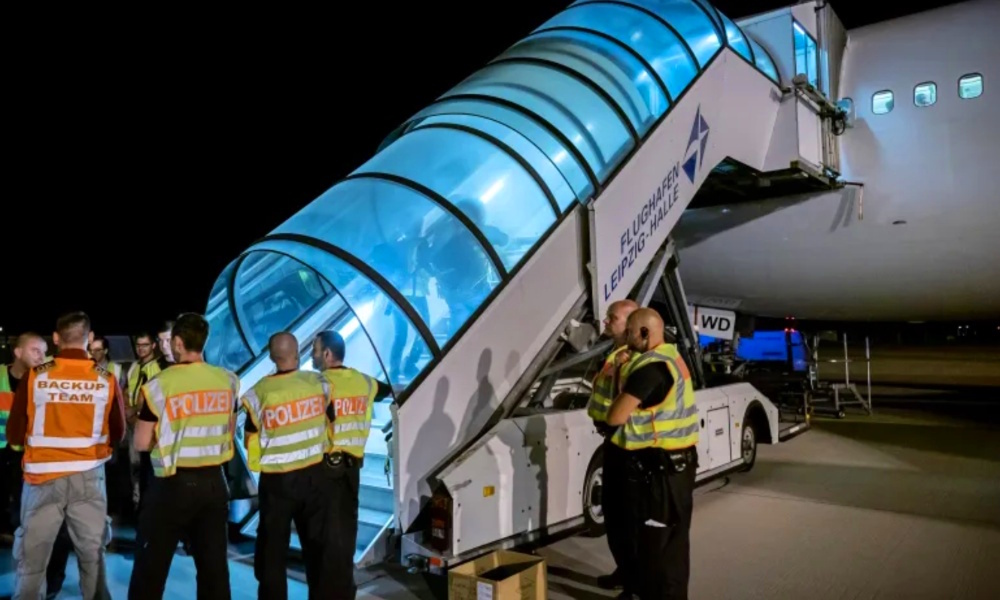
Germany deported 40 Afghan men convicted of criminal offences to Kabul on Wednesday, October 28, aboard a charter flight, as the government continues to expand removals to Afghanistan.
The aircraft departed from Leipzig/Halle Airport and landed directly in Kabul, according to Germany’s Federal Interior Ministry and reports by German media. The operation involved authorities from 10 German states: Baden-Württemberg, Bavaria, Hamburg, Hesse, Lower Saxony, North Rhine-Westphalia, Rhineland-Palatinate, Saarland, Saxony and Saxony-Anhalt.
German authorities said all 40 deportees were men who had committed criminal offences, including manslaughter, rape, sexual abuse of children, assault and drug trafficking.
Interior Minister Alexander Dobrindt defended the policy, saying that convicted offenders must leave Germany and that deportations to Afghanistan had become a regular and reliable part of the country’s migration policy. “Whoever commits serious crimes in Germany must leave our country,” Dobrindt said, according to German media. He added that the government would continue to pursue a consistent deportation regime.
The latest flight marks another step in Berlin’s efforts to resume and expand deportations to Afghanistan following the Taliban’s return to power in August 2021.
Germany resumed deporting Afghan nationals in August 2024, when 28 men convicted of crimes were flown to Kabul with Qatar’s assistance. Berlin had previously suspended deportations following the Taliban takeover and relied on regional intermediaries to facilitate returns because Germany does not formally recognise the Taliban government.
In February 2026, German federal police deported 20 Afghan men directly to Kabul without assistance from a third country, under an arrangement with Taliban authorities, according to German media reports. The arrangement marked a significant shift in Berlin’s approach, as it involved direct cooperation with the Taliban administration despite the absence of formal diplomatic recognition.
Further flights followed during 2026. Germany deported 31 Afghan men in July and 23 in August. A flight carrying 13 people also arrived in Kabul in September, according to reports by German media and human-rights organisations.
The latest deportation involved 40 men from 10 states. German media reported that the federal government had deported a total of 303 Afghan men since the start of the current legislative period. The figures underline the scale of Berlin’s expansion of removals, which has accelerated over the past year.
Human-Rights Concerns Remain
The deportations have drawn criticism from human-rights organisations, which warn that people returned to Afghanistan may face persecution or other serious risks under Taliban rule.
Amnesty International argues that forced returns to Afghanistan can violate the principle of non-refoulement, which prohibits sending people to a country where they face a real risk of persecution, torture or other serious human-rights violations. The organisation has called on Germany to halt deportations and monitor the treatment of people after their return. “Returns to Afghanistan are not safe, and Germany cannot guarantee that returnees will not face serious harm,” Amnesty said in a statement.
Germany’s deportation policy has also expanded beyond convicted offenders. In July 2026, German authorities deported an Afghan man who had no criminal conviction, saying he was legally required to leave after exhausting his asylum process. The decision prompted criticism from opposition politicians and refugee-rights advocates, who argued that the move signalled a broader hardening of migration policy that could affect law-abiding asylum seekers.
Pro Asyl, a German refugee advocacy group, has criticised the deportations as politically motivated and warned that they risk normalising cooperation with the Taliban. The group has urged the government to prioritise safe and legal migration pathways instead of expanding removals.
German officials have defended the policy as part of efforts to enforce deportation orders and tighten migration controls. However, concerns persist over the safety of returnees and the lack of independent monitoring of their circumstances after arrival in Afghanistan. Human-rights groups have repeatedly called for independent observers to be granted access to returnees, but no such monitoring mechanism has been established.
The Interior Ministry has said it would continue to review each case individually and that the deportations were carried out in accordance with German law. The government has also pointed to its efforts to support the reintegration of returnees through international partners, though details of such programmes remain limited.
The debate over Afghan deportations reflects a wider European trend, as several countries have grappled with how to balance security concerns against human-rights obligations following the Taliban’s return to power. Germany’s expanded removals are likely to remain a contentious issue both domestically and internationally as further flights are expected in the coming months.

Support Dawat Media Center
Support Dawat Media Center
If there were ever a time to join us, it is now. Every contribution, however big or small, powers our journalism and sustains our future. Support the Dawat Media Center from as little as $/€10 – it only takes a minute. If you can, please consider supporting us with a regular amount each month. Thank you
DNB Bank AC # 0530 2294668
Account for international payments: NO15 0530 2294 668
Vipps: #557320

Comments are closed.