
Powerful 7.1-Magnitude Quake Strikes Southern Japan, Injuring Dozens and Paralyzing Infrastructure

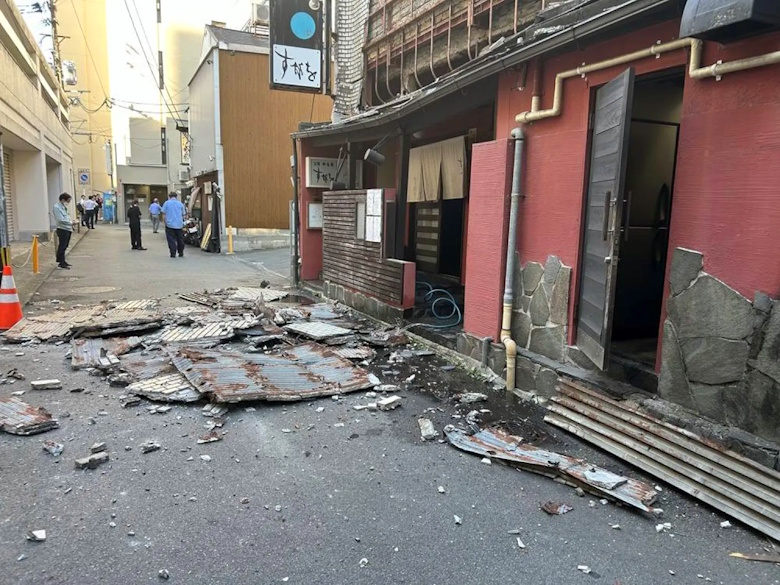
A powerful earthquake rattled Japan’s southern Kumamoto prefecture on Tuesday, leaving at least 50 people injured, cutting power to tens of thousands of homes, tearing open roads, and disrupting rail and air travel across the region. The 7.1-magnitude tremor, which struck in the early evening, sent shockwaves through Kyushu Island and prompted emergency warnings from the government as rescue and assessment efforts got underway.
Speaking to reporters at her office in Tokyo, Japanese Prime Minister Sanae Takaichi said the full scale of casualties and structural damage was still being evaluated, but confirmed that early reports indicated significant destruction. “We have already been informed that people have been injured,” Takaichi stated. “Power outages and fires have occurred in some areas, and there has also been damage to roads and bridges, as well as the collapse of buildings.” She assured the public that disaster response teams had been mobilized and that the government was coordinating with local authorities to expedite relief efforts.
Public broadcaster NHK reported that one local hospital had already treated more than 50 injury cases, ranging from minor cuts and bruises to fractures and head trauma. Separately, the Nikkei newspaper said several passengers aboard a high-speed shinkansen train at the time of the quake were also injured, though their conditions were not immediately disclosed. The train had been traveling between Fukuoka and Kagoshima when the shaking forced an emergency stop.
The quake left a trail of structural devastation across the prefecture. Multiple buildings were damaged, including an Aeon shopping mall in Kumamoto City, which NHK said experienced an explosion likely caused by a gas leak though the extent of the blast and any related casualties remained unclear. Footage from the broadcaster also showed other buildings engulfed in flames or with collapsed upper floors. An Aeon spokesperson could not immediately comment on the situation.
Infrastructure bore the brunt of the seismic jolt. Large fissures split major roadways, including sections of an elevated highway, making travel treacherous and complicating access for emergency vehicles. According to NHK, a freight train derailed near the epicenter, though no serious injuries were reported from that incident. In response, railway operator JR Kyushu suspended all services, including bullet trains, while Kumamoto Airport closed its runway, forcing airlines to divert or cancel dozens of flights. Authorities advised travelers to check for updates before heading to transport hubs.
The industrial impact was swift. TSMC, the world’s largest contract chipmaker, evacuated workers from its semiconductor plant in the area as a precautionary measure, a company spokesperson confirmed. Sony and Fujifilm also reportedly evacuated staff from their nearby manufacturing facilities, according to the Nikkei. A Sony representative earlier said the company was assessing the situation and monitoring for any aftershock-related disruptions to production.
More than 150,000 residents across several prefectures have been instructed to proceed to evacuation centers, the Disaster Management Agency said, as local officials scrambled to set up shelters and distribute food, water, and blankets. The Japan Meteorological Agency (JMA) urged residents in areas that experienced the strongest tremors to remain vigilant for further powerful quakes over the next week, as well as to watch for the heightened risk of landslides in hilly and mountainous zones.
Tsunami Warning Lifted, Nuclear Plants Unaffected
The JMA initially issued a tsunami advisory for a wave of up to one meter (3.28 feet) along parts of Kyushu’s coastline but lifted the warning within a few hours, as no significant surges materialized. Still, coastal communities had earlier been urged to move to higher ground as a safety measure.
Utility companies reported widespread power failures. Kyushu Electric Power said approximately 40,000 households were without electricity, while telecom operators KDDI and Docomo acknowledged disruptions to mobile phone services, attributing them to power shortages and transmission-line damage. Crews were working to restore connectivity and power, but officials warned that some areas could remain in the dark for days.
In a relief for regional safety officials, Japan’s nuclear regulation authority confirmed that no irregularities had been detected at the nuclear power stations in the affected area. All reactors were said to be operating normally or had been safely shut down for inspections, with no radiation leaks reported.
A Region Haunted by Seismic Memory
The quake struck close to the anniversary of a devastating 2016 earthquake in Kumamoto, which claimed 275 lives, injured more than 2,700, and caused extensive damage to thousands of structures, including Kumamoto Castle—one of Japan’s most iconic historical landmarks. Tuesday’s tremor dealt another blow to the already-restored castle; an official at the castle’s office confirmed that portions of its stone walls had collapsed again, raising concerns over the preservation of the cultural treasure.
Japan, situated along the Pacific “Ring of Fire”—a volatile belt of volcanoes and oceanic trenches—is one of the most seismically active nations on Earth, experiencing a tremor at least every five minutes. The country accounts for roughly 20% of all global earthquakes of magnitude 6.0 or higher. This latest event serves as a stark reminder of the nation’s perpetual vulnerability, even as its advanced early-warning systems and strict building codes continue to save lives.
As night fell over Kumamoto, rescue teams continued to search through debris for any trapped individuals, while aftershocks some registering magnitude 5.0 or more kept residents on edge. The government has pledged full support for recovery operations, with Prime Minister Takaichi vowing that “every effort will be made to ensure the safety and well-being of all affected citizens.”
Our Pashto-Dari Website

Support Dawat Media Center
If there were ever a time to join us, it is now. Every contribution, however big or small, powers our journalism and sustains our future. Support the Dawat Media Center from as little as $/€10 – it only takes a minute. If you can, please consider supporting us with a regular amount each month. Thank you
DNB Bank AC # 0530 2294668
Account for international payments: NO15 0530 2294 668
Vipps: #557320

Comments are closed.