

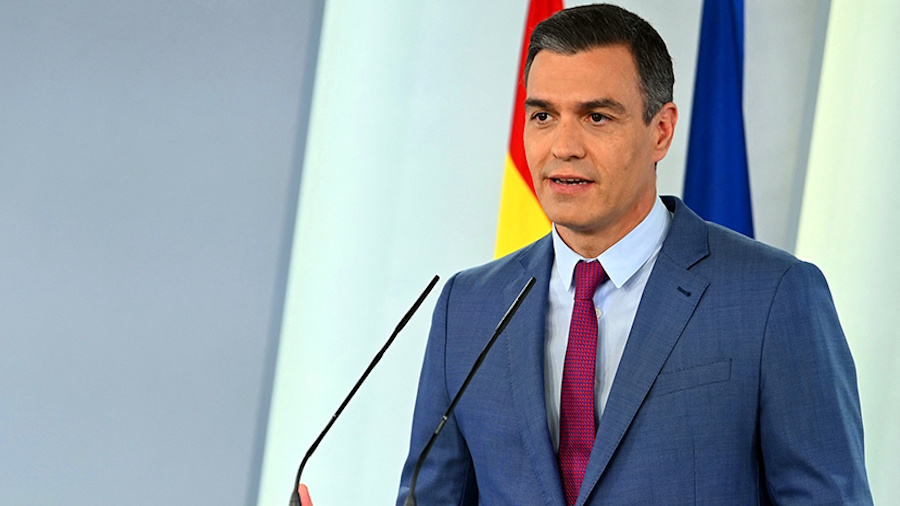
A string of regional elections, culminating in a decisive conservative victory in Andalusia, has highlighted a persistent rightward shift in Spanish politics even as Prime Minister Pedro Sánchez continues to project Spain internationally as a standard-bearer of progressive leadership in an increasingly conservative Europe.
The results reveal a growing disconnect between Spain’s domestic political mood and Sánchez’s international image as one of Europe’s most visible left-leaning leaders. While he has positioned himself abroad as a defender of liberal democratic values and a vocal counterweight to the resurgence of Trump-style politics, voters at home are increasingly rewarding conservative and hard-right alternatives.
Regional defeats expose Socialist weakness
Throughout the year, regional ballots in Aragón, Castilla y León, and Andalusia have delivered a series of setbacks for Sánchez’s Socialist Workers’ Party (PSOE). In each case, the conservative People’s Party (PP) strengthened its position, while the hard-right Vox party consolidated its role as a key power broker capable of determining government formation.
These outcomes suggest that the alliance between Spain’s traditional conservative right and the emerging nationalist hard right is no longer an exception but is becoming a normalized feature of regional politics.
For the Socialists, the losses represent more than local dissatisfaction. They point to a broader protest vote and, to some extent, a rejection of the progressive agenda promoted by Sánchez’s government in Madrid.
This trend contrasts sharply with Sánchez’s standing abroad, where he has cultivated a reputation as one of Europe’s last major progressive leaders during an era marked by the global resurgence of nationalist conservatism.
His profile has only grown as other centre-left leaders across Europe have struggled. Following Denmark’s Mette Frederiksen’s earlier difficulties in forming a government, Sánchez remains one of the European Union’s most prominent left-leaning prime ministers still in office.
Admired abroad, divisive at home
The contrast between Sánchez’s international stature and domestic standing has become one of the defining paradoxes of his leadership.
Internationally, he is often praised for his independent foreign policy positions, particularly his outspoken stance on Gaza, his willingness to challenge Donald Trump’s political worldview, and his efforts to place Spain at the center of global progressive discussions.
He has also expanded Spain’s diplomatic footprint significantly, strengthening ties with Latin America, the Arab world, and increasingly China. Diplomatic sources describe Sánchez as having positioned Spain as a bridge-builder between Europe and emerging geopolitical powers.
Critics, however, argue that this expanded international visibility has produced few tangible benefits for Spain itself or for Europe more broadly. They contend that his foreign policy activism often appears designed more to elevate his personal profile than to deliver measurable strategic gains.
At home, Sánchez remains one of Spain’s most polarizing political figures.
His government has enacted a range of progressive domestic policies, including pension increases, significant minimum wage rises, and a major initiative to regularize approximately half a million undocumented immigrants a move his administration has described as offering a path to “dignified” living conditions.
Yet these achievements are often overshadowed by persistent political instability, legal investigations involving members of his family allegations he strongly denies and criticism over his dependence on fragile parliamentary alliances.
Regional politics do not always predict national outcomes
Despite losing much of PSOE’s territorial influence outside Catalonia, Sánchez has repeatedly shown an ability to outperform expectations in national contests.
The clearest example came in 2023. After suffering heavy regional losses widely interpreted as the start of a conservative “blue wave” blue being the PP’s political color Sánchez surprised observers by calling an early general election.
Though PSOE finished second nationally behind the PP, Sánchez succeeded in narrowing the gap sufficiently to build a governing coalition by uniting a fragmented bloc of left-wing, nationalist, and pro-independence parties.
In Spain’s parliamentary system, electoral victory is not determined solely by which party wins the most votes, but by who can secure a governing majority in parliament. Sánchez mastered this arithmetic once again.
His inner circle believes the same formula could be repeated in 2027, when Spain next heads to the polls.
The strategy depends on mobilizing progressive voters through fear of a potential coalition between the PP and Vox a prospect many on the left view as a threat to social rights, minority protections, and liberal democratic norms.
Sánchez has consistently argued that a right-wing alliance would reverse many of the social advances achieved under his administration and usher in a more socially conservative era.
Fatigue and parliamentary paralysis
Still, the path to another term is increasingly complicated.
Sánchez’s government has struggled to pass even routine legislation. Spain has not approved a new national budget since 2023 due to insufficient parliamentary support, forcing the administration to operate under outdated financial frameworks.
While Spain’s economy has performed better than many of its European counterparts helping insulate Sánchez from immediate economic backlash legislative paralysis raises questions about long-term governability.
There is also growing voter fatigue.
Having governed since 2018 after toppling Mariano Rajoy through a historic no-confidence vote, Sánchez is now Spain’s second-longest-serving democratic leader.
His longevity, once seen as evidence of extraordinary political resilience, increasingly risks being interpreted as political exhaustion.
Still, few expect him to step aside voluntarily.
Sources close to the prime minister insist he is determined to seek re-election, and no serious internal successor has emerged. As PSOE secretary-general, Sánchez has spent years consolidating control of the party apparatus, sidelining both rivals and former allies.
His political philosophy was laid bare in his 2019 memoir, Manual de Resistencia (“Manual of Resistance”), where he presented endurance itself as his defining strength.
That instinct for survival has repeatedly rescued his career.
Our Pashto-Dari Website

Support Dawat Media Center
If there were ever a time to join us, it is now. Every contribution, however big or small, powers our journalism and sustains our future. Support the Dawat Media Center from as little as $/€10 – it only takes a minute. If you can, please consider supporting us with a regular amount each month. Thank you
DNB Bank AC # 0530 2294668
Account for international payments: NO15 0530 2294 668
Vipps: #557320

Comments are closed.