

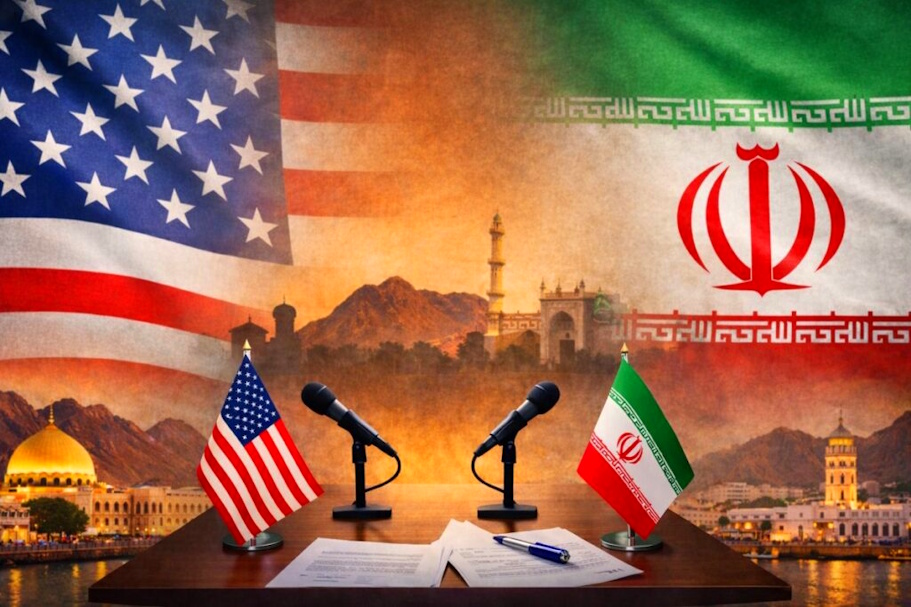
Geneva Peace Talks Set to Begin
Initial talks between the United States and Iran are planned at the Bürgenstock mountaintop resort in Switzerland on Friday, following the signing of a ceasefire agreement between Tehran and Washington, the Swiss government said on Thursday . The meeting will bring together representatives from the US and Iran, along with mediators Pakistan and Qatar, for initial negotiations about implementing the agreement .
The Swiss foreign ministry confirmed that the discussions will focus on the early stages of implementing the ceasefire framework recently agreed between Washington and Tehran. However, the ministry stressed that no further details regarding the schedule, format, or agenda of the meeting were available at this stage .
“As things stand, the plan is still for the US and Iran, along with mediators Pakistan and Qatar and other involved countries, to meet tomorrow at Bürgenstock for initial negotiations about implementing the agreement. No further information is currently available regarding the schedule and details of this meeting,” the Swiss foreign ministry said in a statement .
The Islamabad Memorandum of Understanding
The upcoming talks follow the historic signing of the “Islamabad Memorandum of Understanding” (MoU) on Wednesday, which was electronically signed by US President Donald Trump and Iranian President Masoud Pezeshkian . Pakistan Prime Minister Shehbaz Sharif signed the document on Thursday as a guarantor, confirming Pakistan’s role as the key mediator in the negotiations .
The agreement aims to draw a line under the war launched February 28 by the United States and Israel, which prompted Iran to counterattack with missile and drone salvos across the region and effectively shut down the Strait of Hormuz, a crucial waterway for the world economy . The US responded by blocking shipping to and from Iranian ports .
The 14-Point Peace Plan
The MoU outlines a comprehensive 14-point peace plan with detailed provisions for de-escalation and normalization of relations . Below are the key points:
-
Immediate termination of military operations on all fronts, including in Lebanon, and a commitment from both parties not to initiate any war or military operation against each other, ensuring the territorial integrity and sovereignty of Lebanon .
-
Respect for sovereignty and territorial integrity, with both parties refraining from interfering in each other’s internal affairs .
-
Commitment to negotiating a final deal within a maximum of 60 days, extendable with mutual consent .
-
Immediate removal of the US naval blockade and any disturbances against Iran, with full implementation within 30 days. During this period, vessel traffic will be restored in proportion to pre-war numbers .
-
Iran will arrange safe passage for commercial vessels through the Strait of Hormuz, with the traffic of commercial vessels starting immediately and full restoration within 30 days following the removal of technical obstacles and demining .
-
A $300 billion reconstruction and economic development fund for Iran, to be developed with regional partners and finalized as part of the final deal within 60 days .
-
Termination of all types of sanctions against Iran, including those imposed by UN Security Council resolutions .
-
Nuclear program commitments: Iran reaffirms it shall not procure or develop nuclear weapons. The parties agree to resolve the disposition of stockpile enriched material under IAEA supervision, with the final deal confirming these provisions .
-
Status quo maintenance: Pending the final deal, Iran will maintain the current status of its nuclear program, and the US will not impose new sanctions or deploy additional forces in the region .
-
Waivers for Iranian oil exports and associated services, including banking transactions, insurance, and transportation, to be issued immediately by the US Department of Treasury .
-
Release of frozen Iranian funds and assets (worth up to $164 billion) upon implementation of the MoU, with procedures to be mutually agreed upon during negotiations .
-
Establishment of an executive mechanism to monitor successful implementation of the MoU and future compliance with the final deal .
-
Negotiations regarding the final deal will begin after the implementation of paragraphs 1, 4, 5, 10, and 11 of the MoU .
-
The final deal will be endorsed by a binding UN Security Council resolution .
Diplomatic Context and Mediation
Pakistan has played a crucial role in bringing the parties together. Prime Minister Sharif hailed Trump and Iran’s Supreme Leader Mojtaba Khamenei for restoring peace in West Asia, announcing that the signing of the document will instantly reopen the Strait of Hormuz and that the US will immediately lift its naval blockade .
Qatar, another key mediator, has expressed its commitment to supporting Pakistan’s mediation efforts. Majed al-Ansari, an advisor to the Qatari prime minister and spokesperson for the Foreign Ministry, stated: “We support Pakistan-led mediation. Pakistan has played an important role in bringing us here and it will continue to play the role of the key intermediary between the United States and Iran” .
The peace process was negotiated through mediators that included Pakistan and Qatar, who initially secured a two-week ceasefire agreement on April 8. This ceasefire was extended until the completion of the talks . The first round of peace talks was hosted by Pakistan in April, attended by senior leaders from both sides, though they failed to clinch a deal at that time .
Regional Implications
The agreement is viewed as a significant diplomatic breakthrough following months of heightened tensions. Iran insisted the deal represented a US “failure,” while Prime Minister Sharif offered “heartfelt congratulations and sincere appreciation” to Trump, saying his “steadfast commitment to diplomacy and preference for peaceful resolution have once again helped end a conflict that could have led to devastating consequences for the region and beyond” .
The Bürgenstock resort, located in central Switzerland, has previously hosted high-level diplomatic meetings and is being used again as a neutral venue for the sensitive negotiations . The talks come after the announcement of a ceasefire agreement earlier this week, which has been presented as a step towards de-escalation after months of heightened tensions .
Our Pashto-Dari Website
Support Dawat Media Center
If there were ever a time to join us, it is now. Every contribution, however big or small, powers our journalism and sustains our future. Support the Dawat Media Center from as little as $/€10 – it only takes a minute. If you can, please consider supporting us with a regular amount each month. Thank you
DNB Bank AC # 0530 2294668
Account for international payments: NO15 0530 2294 668
Vipps: #557320

Comments are closed.