

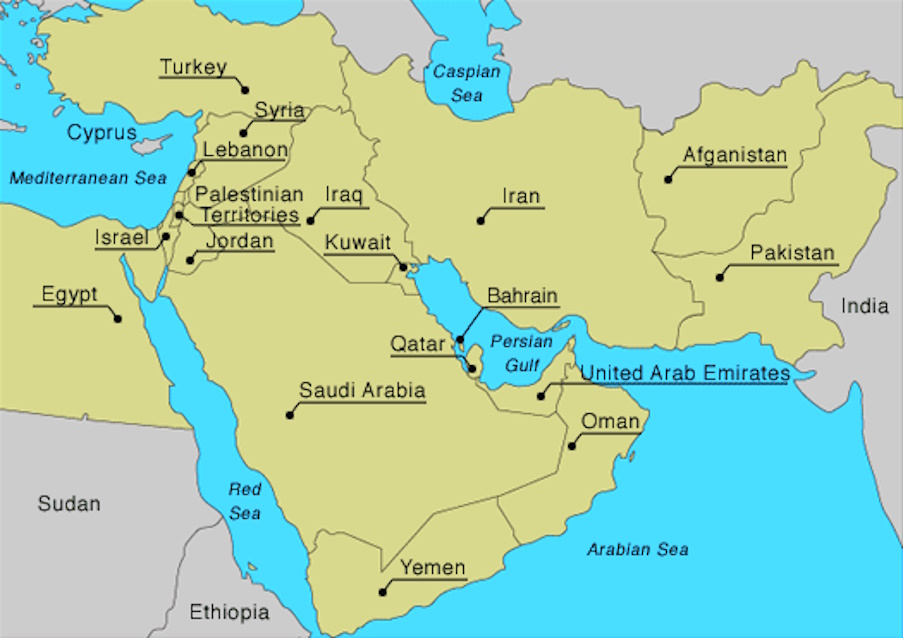
When we were studying in Germany during the 1970s, the country was crowded with organizations of the new Iranian leftist student movements, while inside Iran the Communist Tudeh Party was the strongest political force, unmatched in influence in the broader Middle East except perhaps by its counterparts in Indonesia and Sudan. For this reason, nearly everyone expected a military coup to eventually seize power, as had happened in many Arab and Islamic countries.
Naturally, such a transformation did not necessarily have to be leftist in character. It could just as easily have been engineered by the Americans, as had happened in the 1950s when they intervened to shield Iran from communism. Yet what ultimately occurred was something no one had anticipated: Iran’s clerical establishment seized power through a vast and turbulent popular revolution, all under the watchful eyes of the Americans and the West.
The United States’ abandonment of the Shah’s regime was swift, dramatic, and to this day remains difficult to fully explain. The apparent alternative American choice was to confront the communist threat by empowering the radical Islamist project of the mullahs. Indeed, Khomeini quickly moved to crush the Tudeh Party and other leftist organizations before turning his attention to suppressing Iran’s pro-American and liberal forces.
For many of us in the Arab world, astonishment at the Iranian Revolution persisted for years.
By 1985, when Iranian forces had seized Majnoon Island and its oil fields and began openly speaking of taking Basra and either annexing it to Iran or establishing an Islamic republic there, I remained deeply interested in examining the sectarian dimensions of the revolution and its influence on Shiite youth throughout the Arab world—including among leftist circles.
At that time, the late and distinguished scholar Roy Mottahedeh, professor of Islamic history at Harvard University, told me he was writing a book on the Iranian character and the secrets behind clerical authority in Iran. He asked me to respond to questions that had arisen after reading my 1984 book The Nation, the Community, and Authority.
His book appeared in 1986 under the striking metaphorical title The Mantle of the Prophet, with the subtitle Religion and Politics in Iran. It was reprinted many times, selling hundreds of thousands of copies, and was widely regarded as one of the finest books written on any Muslim country in half a century.
Interestingly, although Iranians rush to translate nearly everything written about their country, this book was never translated into Persian because many considered it hostile to Iran. I, however, have always believed it to be fundamentally sympathetic and deeply insightful.
There are indeed a few pages criticizing the conduct of the clerical establishment toward minorities particularly the Bahá’ís (Mottahedeh himself came from a Bahá’í background) as well as observations on mass executions and the suppression of freedoms. Beyond that, however, his portrayal of the Iranian character is rich, captivating, and profound.
He describes Iranian society as possessing an ancient Aryan-style class structure. After centuries under Islam, the clergy especially the sayyids, descendants of the Prophet’s family emerged as a distinct social class rooted among the devout masses. Sustained financially through the religious tax of khums, they often existed outside direct political authority while not always opposing it.
Their true rivals were the rural aristocracy, known among Arabs as the dehqans, who regarded themselves as the guardians of Iranian nationalism. Yet during moments of national crisis, these two classes often converge, either rallying behind the reigning shah or enabling aristocratic leadership to return from within or beyond Iran’s borders, as happened under both the Safavid and Qajar dynasties.
According to Mottahedeh whose book I translated more than fifteen years after its publication under the Arabic title The Mantle of the Prophet Iranian national solidarity is built upon a dual foundation: Shi‘ism and nationalism.
This dual identity often manifests as defiance, rebelliousness, and an intense sense of historical entitlement whenever a charismatic leader emerges. It is further shaped by another duality: geography and historical role. Whenever a unified state consolidates power on the Iranian plateau, it tends to develop expansionist ambitions in every direction, seeking to reconstruct an empire extending far beyond the plateau’s natural borders a pattern visible for nearly three thousand years.
The Arabs have long been perplexed in dealing with Iran, despite their ancient familiarity with their neighbor.
Saddam Hussein attacked Iran because he feared its influence over his regime. Other Arab states, however, sought accommodation and conciliation with Iran for decades. Yet with only rare exceptions, Iran’s responses were negative. Arab tolerance, strategic patience, and hopes for change often enabled Iranian influence to destabilize and damage several Arab countries.
When the Americans and Israelis confronted Iran, the Arab states largely remained neutral and sought to prevent war.
Yet Iran nevertheless struck hard within the Gulf states, particularly in United Arab Emirates.
This remains a source of genuine perplexity regarding this troubled neighborhood.
At times, Iran devastates Arab countries through proxy militias under the banner of Palestine only for the consequences to rebound disastrously upon itself, the Palestinian people, and the Lebanese people alike.
At other times, it claims its attacks are meant to harm the Americans, yet the practical result is only to deepen regional dependence on American protection.
It is, as Imam Ali ibn Abi Talib once said, a conduct that leaves behind only sickness and exhaustion.
It is a blind hostility that begins in perceived weakness and seeks strength through weakening others.
Either those affected by this pattern unite around a strategy of deterrence and confrontation, or the security of the region’s stable and prosperous states will remain under threat and all may sink into the same quagmire into which Iran itself has fallen:
the quagmire of internal disorder, the manufacture of enemies, and the alienation of friends.
Our Pashto-Dari Website

Support Dawat Media Center
If there were ever a time to join us, it is now. Every contribution, however big or small, powers our journalism and sustains our future. Support the Dawat Media Center from as little as $/€10 – it only takes a minute. If you can, please consider supporting us with a regular amount each month. Thank you
DNB Bank AC # 0530 2294668
Account for international payments: NO15 0530 2294 668
Vipps: #557320

Comments are closed.