
Tens of thousands march in London as far-right rally clashes symbolically with pro-Palestine Nakba Day protest

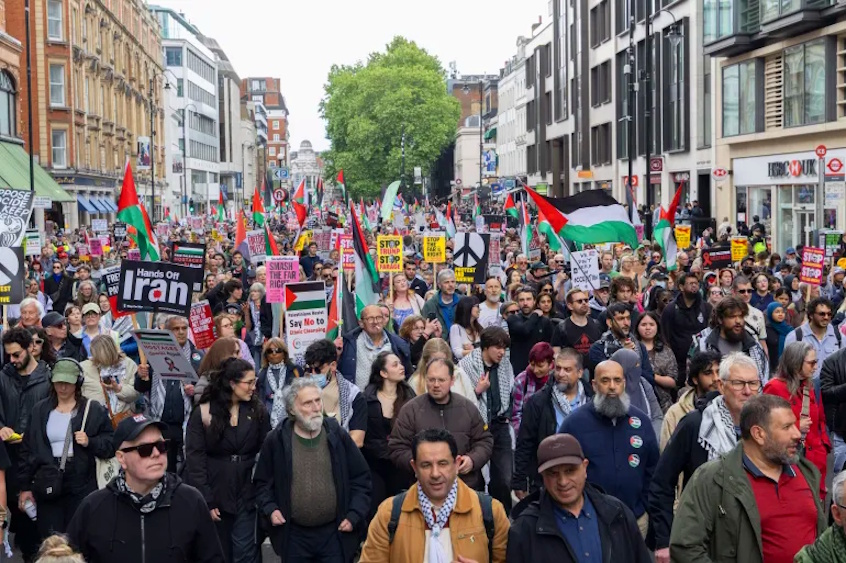
London’s streets saw heightened security and tense but largely peaceful rival demonstrations on Saturday, as a far-right march led by Tommy Robinson coincided with a major pro-Palestine rally marking Nakba Day.
Tens of thousands of people converged on central London for two opposing protests: one a pro-Palestine demonstration held a day after the annual commemoration of the Nakba (“catastrophe” in Arabic), and the other a far-right, anti-immigration rally organised by the controversial activist Tommy Robinson.
In response, the Metropolitan Police deployed 4,000 officers including reinforcements from forces outside the capital in what officials described as the biggest public order operation in years. Authorities pledged “the most assertive possible use of our powers” to prevent violence between the rival groups.
Security, arrests, and facial recognition
Police had forecast a combined turnout of at least 80,000 people roughly 50,000 at Robinson’s “Unite the Kingdom” march and 30,000 at the Nakba Day rally. In a late-afternoon update, the Met said the duelling events had “proceeded largely without significant incident,” with 31 arrests made by that point for offences including public order violations and possession of offensive weapons.
Armoured vehicles, mounted police, dogs, drones, and helicopters were deployed to monitor the protests. For the first time, live facial recognition technology was used to scan crowds for wanted individuals or those subject to court orders. The police also imposed strict conditions on both rallies including route and timing restrictions to keep rival attendees apart. Organisers were made legally responsible for ensuring invited speakers did not break hate speech laws, another first.
The Crown Prosecution Service instructed prosecutors to consider whether certain placards or chants might amount to criminal offences or deliberately stir up aggression. “This is not about restricting free speech,” said CPS director Stephen Parkinson. “It is about preventing hate crime and protecting the public, particularly at a time of heightened tensions.”
The operation is estimated to cost £4.5 million ($6 million). Prime Minister Keir Starmer, whose Labour government has faced mounting pressure after strong local election gains by the far-right Reform UK party, warned on the eve of the protests: “Anyone who sets out to wreak havoc on our streets … can expect to face the full force of the law.” He accused Robinson’s organisers of “peddling hatred and division.”
Far-right rally: immigration and “national unity”
Aerial footage broadcast by UK media showed tens of thousands gathered at Robinson’s rally, a sea of Union Jacks, English St George’s crosses, and other nationalist flags. Robinson whose real name is Stephen Yaxley-Lennon is a prominent far-right figure with a history of convictions for fraud, assault, and contempt of court.
“Immigration’s the main concern,” said Christine Turner, 66, from northeast England. “We’re an island. We’ve got a clear border that they’re not protecting. Something needs to be done. It’s gone on too long.”
The British government had pre-emptively blocked 11 foreign nationals from entering the country for the “Unite the Kingdom” rally. Those barred reportedly included Polish politician Dominik Tarczynski, Belgian far-right politician Filip Dewinter, Colombian-American anti-Islam commentator Valentina Gomez, and Dutch activist Eva Vlaardingerbroek.
Saturday’s march echoed a similar Robinson-led rally last September, which drew around 110,000 people to central London under the banner of “national unity, free speech and Christian values.” That event shocked many in the UK for its scale and directness, and led to violent clashes with police that left dozens of officers injured. It was notably addressed by X owner Elon Musk, who has since amplified far-right content on his platform.
Pro-Palestine march: “love, kindness and hope”
Just a few miles away, pro-Palestine demonstrators gathered with Palestinian flags and placards, calling for an end to Israel’s ongoing military campaign in Gaza. The march was held to mark Nakba Day observed annually on May 15 commemorating the mass displacement of approximately 750,000 Palestinians from their homes during the 1948 Arab-Israeli war that led to the creation of the state of Israel.
This year’s commemoration came against the backdrop of a devastating war in Gaza that has killed more than 35,000 Palestinians, according to local health officials, and displaced nearly the entire population of 2.3 million.
“Israel’s behaviour is unjust beyond belief,” said Sharon De-Wit, a protester. “After the Holocaust … all you can do is wish the Jewish people all the best. But they won’t be able to live in peace until they allow the Palestinian people to form their own state.”
Another demonstrator, Ali Haydor, reflected on the broader societal divide. “The society is divided, and a lot of it is a failure of the last 40-plus years of political decision-making,” he said. “It’s sad that you’ve got two groups of people separated based on division and hate. But I think if you look at here, there is no hate or division. This is all about love, kindness and hope. And what we say to the other group: join us in that hope and kindness, because that’s where the better future is — not the other side.”
This year, the anti-racism group Stand Up to Racism merged its annual antifascist march with the pro-Palestine Nakba Day demonstration, underscoring the growing solidarity between Palestinian rights activists and broader anti-racism movements in the UK.
Looking ahead
While Saturday’s rival protests passed without major violence, the sheer scale of both gatherings and the heavy police response highlighted deep and persistent divisions within British society. The far-right’s growing ability to mobilise tens of thousands, combined with sustained pro-Palestine activism, suggests that the clash of worldviews seen on London’s streets is unlikely to fade anytime soon.
For now, the Metropolitan Police have defended their handling of the operation, but civil liberties groups have raised concerns over the use of live facial recognition and the pre-emptive exclusion of foreign nationals. Whether these tactics become standard for future protests remains an open and contentious question.
Our Pashto-Dari Website

Support Dawat Media Center
If there were ever a time to join us, it is now. Every contribution, however big or small, powers our journalism and sustains our future. Support the Dawat Media Center from as little as $/€10 – it only takes a minute. If you can, please consider supporting us with a regular amount each month. Thank you
DNB Bank AC # 0530 2294668
Account for international payments: NO15 0530 2294 668
Vipps: #557320

Comments are closed.