

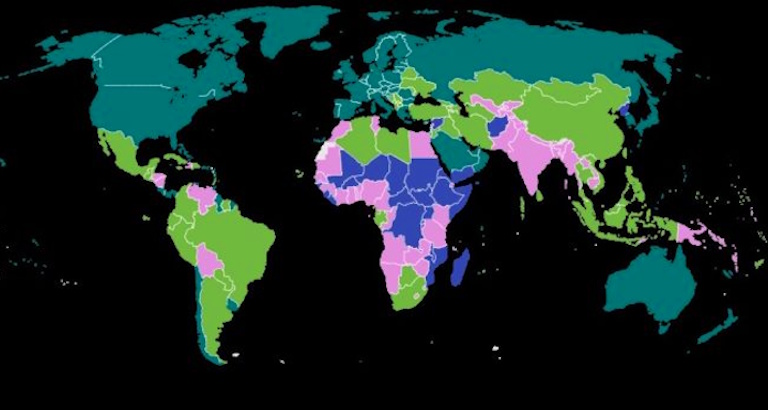
The World Bank has reaffirmed Afghanistan’s classification as a low-income economy for the 2026–27 fiscal year, underscoring the country’s entrenched position among the world’s most impoverished nations. The designation comes at a time when the global trend has shifted toward upward mobility, with several economies graduating to higher income tiers.
According to the Bank’s latest country income classifications, which cover 218 economies, Afghanistan remains one of only three Asian nations alongside Syria and Yemen—to fall within the lowest income bracket. All other countries across South Asia, the Middle East, East and Southeast Asia, and Central Asia have either maintained or improved their standings, reflecting varied but generally positive growth trajectories in the region.
This year’s review saw six countries move into higher income categories. Notably, Sri Lanka, Jordan, Vietnam, and the Philippines advanced to upper-middle or lower-middle-income status, while Togo graduated from low-income to lower-middle-income, partly due to a downward revision in its population estimates. These shifts highlight diverse pathways to economic progress, ranging from Vietnam’s robust export-driven manufacturing to Sri Lanka’s gradual recovery from its 2022 sovereign debt and political crisis.
Afghanistan’s Economic Strain Persists
Afghanistan’s static ranking is hardly surprising given the compounded shocks it has endured since the Taliban takeover in August 2021. The economy has contracted sharply, with the collapse of foreign-funded institutions, the freezing of central bank assets, and the severing of development assistance that once underpinned nearly half of public expenditure. Today, the country faces a chronic liquidity crunch, soaring unemployment, and a private sector crippled by banking restrictions, erratic policy signals, and infrastructural decay.
The World Bank classifies Afghanistan under the Middle East, North Africa, Afghanistan, and Pakistan (MENAAP) regional grouping a reclassification introduced in 2025 that moved it out of South Asia which affects how regional economic data is compared and aid coordinated.
Beyond macroeconomic indicators, the humanitarian dimension remains dire. Over 90% of the population is estimated to live below the poverty line, and food insecurity afflicts more than half of all households. The World Bank emphasizes that its income classification, which is based primarily on gross national income (GNI) per capita, does not directly measure poverty, inequality, or access to services. However, supplementary reports from the institution have repeatedly warned that Afghanistan’s recovery is fragile, and that restrictions on women’s education and employment, combined with shrinking civic space, are eroding human capital and long-term productivity.
Large-scale population movements have further strained the economy. Since 2023, millions of Afghan migrants have returned from Pakistan and Iran, often under duress, exacerbating housing shortages, overwhelming public services, and intensifying competition for scant jobs in already saturated urban centers.
Global Progress, Uneven Gains
The World Bank notes that the global share of low-income economies has fallen dramatically from 30% in 1987 to roughly 11% today yet progress has been uneven, with conflict, climate vulnerability, and institutional fragility hindering gains in the poorest cohorts. The 2026–27 classifications underscore that while many nations are climbing the development ladder, Afghanistan remains tethered to the bottom rung, with little immediate prospect of graduation without a fundamental shift in policy, governance, and international engagement.
For Afghanistan, the sustained low-income status is not merely a statistical label but a stark reflection of the scale of its recovery gap. Analysts argue that reversing this trajectory will require not only humanitarian support but also durable policies to rebuild productive capacity, restore private-sector confidence, reopen educational pathways for all citizens, and reestablish credible fiscal and monetary frameworks. Without such measures, the country risks remaining trapped in a cycle of poverty that neither aid nor remittances alone can break.
Our Pashto-Dari Website
Support Dawat Media Center
If there were ever a time to join us, it is now. Every contribution, however big or small, powers our journalism and sustains our future. Support the Dawat Media Center from as little as $/€10 – it only takes a minute. If you can, please consider supporting us with a regular amount each month. Thank you
DNB Bank AC # 0530 2294668
Account for international payments: NO15 0530 2294 668
Vipps: #557320

Comments are closed.