
A Gold-Fueled Mining Rush Scars Brazil’s Amazon, Spiking Deforestation and Mercury Risks

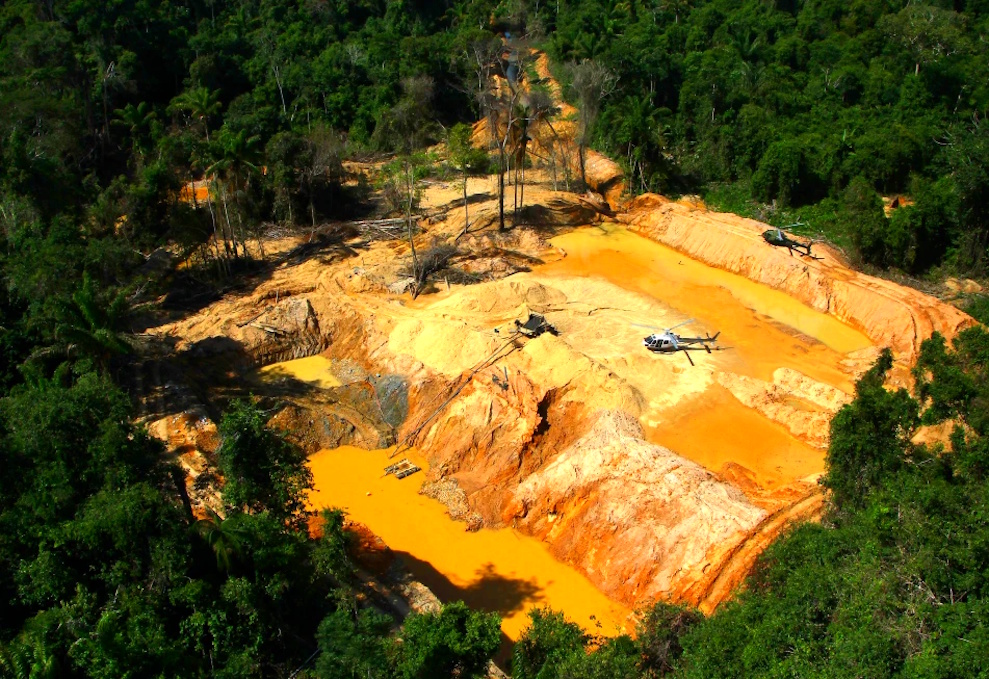
SAO PAULO (AP) — A relentless surge in global gold prices has ignited a new mining rush deep in Brazil’s Amazon rainforest, accelerating deforestation in protected areas and unleashing hazardous levels of mercury contamination on Indigenous and riverine communities, according to officials and environmental experts.
While large-scale agriculture remains the leading cause of Amazon forest loss, illegal gold mining has become one of the most insidious threats disproportionately targeting conservation zones and Indigenous territories. The violence, environmental devastation, and public health crisis left in its wake are drawing alarm from global researchers and human rights groups.
Mining Invades Pristine Reserves
A study released Tuesday by the nongovernmental organization Amazon Conservation, in partnership with Brazilian nonprofit Instituto Socioambiental, documented illegal mining encroachment inside three protected areas of the Xingu region one of the world’s largest continuous blocks of conserved tropical forest, spanning the states of Pará and Mato Grosso. The analysis combined satellite imagery with on-the-ground investigations.
-
Terra do Meio Ecological Station recorded its first illegal mining activity in September 2024. By the end of 2025, mining-related deforestation there had expanded to 30 hectares (74 acres).
-
Altamira National Forest saw a cumulative 832 hectares (2,056 acres) cleared by illegal mining between 2016 and September 2025. A new mining front that opened in 2024 grew to 36 hectares (89 acres) by October 2025, accounting for nearly half of the unit’s mining-related deforestation that year.
-
Nascentes da Serra do Cachimbo Biological Reserve where satellite monitoring also detected a clandestine airstrip used by illegal miners — saw mining-related clearing jump from just 2 hectares (5 acres) to at least 26.8 hectares (66 acres) in 2025 alone.
Most Mining Deforestation Is Illegal
In 2023, Amazon Conservation partnered with Earth Genome and the Pulitzer Center to launch Amazon Mining Watch, a platform that tracks mining activity across the basin using satellite data dating back to 2018. Since then, roughly 496,000 hectares (1.23 million acres) of rainforest have been cleared for mining across the Amazon, including approximately 223,000 hectares (551,000 acres) in Brazil. The organization estimates that 80% of mining-related deforestation in Brazil carries a high risk of being illegal.
Although mining remains a relatively small driver of total Amazon deforestation which reached some 579,600 hectares (1.43 million acres) in 2025, according to official Brazilian data its impact is concentrated in the most ecologically and legally sensitive areas. Mining accounted for roughly 17,000 hectares (42,000 acres) of that total.
“What makes mining particularly problematic is that it specifically targets protected areas and Indigenous territories,” said Matt Finer, director of Amazon Conservation’s Monitoring of the Andes Amazon Program. “These are zones that should have the highest levels of protection.”
Enforcement: A ‘Cat-and-Mouse’ Game
In 2023, Brazilian authorities launched a major crackdown on illegal gold mining in the Yanomami Indigenous Territory in Roraima state, near the Venezuelan border, after a surge in mining caused a humanitarian and health crisis. Annual growth in newly mined areas there fell sharply after the operation, according to Amazon Conservation data. Nearly all deforestation inside the Yanomami territory about 5,500 hectares (13,590 acres) had taken place by 2023, with little new clearing since.
Yet localized success has not stopped the broader crisis. When authorities destroy dredges and equipment in one region, miners often flee and reopen operations elsewhere, or simply return once officials leave.
“Last year, I took part in an operation that destroyed more than 500 dredges on an Indigenous land,” said federal prosecutor André Luiz Porreca, who investigates illegal mining in the western Brazilian Amazon. “The following week, Indigenous people showed me photos proving the miners had already returned.”
Porreca described enforcement as a perpetual “cat-and-mouse game,” noting that illegal gold mining is now financed by Brazil’s largest criminal organizations, including the Red Command and the First Capital Command (PCC) , which operate in about a third of all municipalities in the Brazilian Amazon. “They have the money to bankroll these operations. Some dredges cost as much as 15 million reais” (roughly $3 million USD).
Mercury Contamination Reaches Dangerous Levels
Soaring gold prices driven by investor demand for safe-haven assets amid global instability have supercharged the illegal mining economy.
“It’s basic market logic. With more buyers, there are more people exploiting gold,” Porreca said. He added that Brazil’s mineral export control system remains weak, allowing sophisticated laundering schemes that give illegally extracted gold the appearance of legitimacy.
The environmental toll extends far beyond trees. Illegal miners use liquid mercury to bind gold particles from sediment. When heated, the mercury vaporizes, leaving gold but much of the heavy metal is released into rivers and soils, where it transforms into neurotoxic methylmercury, accumulating in fish and, ultimately, in the bodies of people who rely on the river for food and water.
In April, Porreca submitted a report to the Inter-American Commission on Human Rights detailing widespread mercury contamination across the Amazon. The report cited a study by Fiocruz, a Brazilian public health research institution, which found that:
-
21.3% of fish sold in public markets across the Amazon exceeded mercury limits set by the World Health Organization (WHO).
-
Children aged 2 to 4 years old were consuming mercury at levels up to 31 times higher than the recommended maximum.
Long-term mercury exposure can cause irreversible neurological damage, especially in fetuses and young children, impairing cognitive development, motor skills, and memory.
Indigenous Lands Under Siege
While enforcement has eased pressure in Yanomami territory, illegal mining has intensified elsewhere particularly across Indigenous lands in the Xingu River basin. The most critical hotspot is the Kayapo Indigenous Territory, where roughly 7,940 hectares (19,620 acres) of rainforest have been cleared by illegal mining the largest area of any Indigenous or protected zone in the Brazilian Amazon.
Under Brazilian law, mining is prohibited on Indigenous lands. Brazil’s Ministry of Indigenous Peoples said in a statement that combating illegal mining on Indigenous territories is a priority of President Luiz Inácio Lula da Silva’s administration. However, the ministry acknowledged that mining invasions are sustained by powerful criminal networks and that meaningful enforcement requires dismantling their economic and logistics chains not simply destroying equipment.
The Ministry of Environment separately stated that mercury contamination from illegal gold mining remains a persistent and worsening problem, adding that it is expanding scientific monitoring while supporting federal police operations.
A Broader Climate and Human Rights Emergency
Protecting Indigenous territories is widely recognized as one of the most effective strategies for curbing deforestation in the Amazon, which serves as a critical regulator of global rainfall and carbon storage. Researchers warn that continued degradation through mining, logging, or agricultural fires could accelerate climate change beyond recovery thresholds.
For now, the miners keep coming. With gold prices expected to remain high and criminal financing deeper than ever, environmental groups warn that the Amazon’s most protected places face an uncertain future and the people who live there face a silent, mercury-laced threat that will last for generations.
Support Dawat Media Center
If there were ever a time to join us, it is now. Every contribution, however big or small, powers our journalism and sustains our future. Support the Dawat Media Center from as little as $/€10 – it only takes a minute. If you can, please consider supporting us with a regular amount each month. Thank you
DNB Bank AC # 0530 2294668
Account for international payments: NO15 0530 2294 668
Vipps: #557320

Comments are closed.