

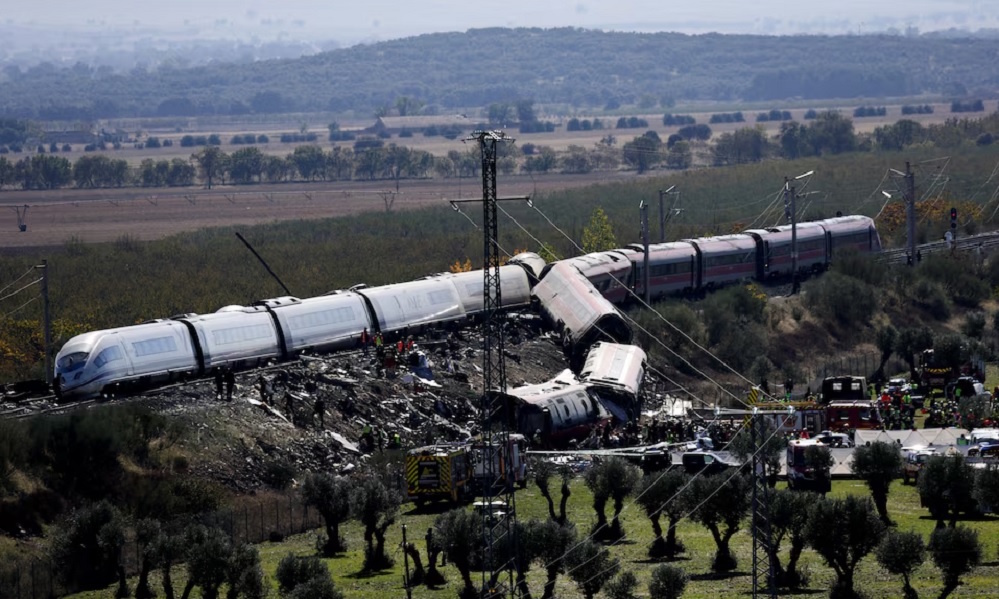
At least 68 people have died after a Spanish high-speed express train slammed into a stationary train on Wednesday, with rescuers scouring mangled carriages for more bodies into the night. The disaster marks Spain’s second fatal rail crash this year and Europe’s deadliest train accident since 2013.
A System That Failed
Prime Minister Pedro Sánchez said “all of Spain” was in mourning following the collision. Transport Minister Óscar Puente told reporters in Madrid that the crash occurred after a Renfe service was authorized to proceed despite an active red signal warning of a stationary train ahead.
The red signal had been triggered by a computer communications failure that automatically halted traffic, Puente explained. However, an erroneous decision was then taken to restart the Renfe train a decision that would prove catastrophic.
Sánchez, speaking in a televised address from near the crash site south of Madrid, vowed a thorough investigation. “This terrible tragedy will be investigated,” he said, pledging to address any failures that come to light. He added that the causes of the two crashes this year appeared to be unrelated.
“If we need to further strengthen safety in order to rebuild confidence in our high-speed rail system, we will do so, because what is unacceptable for a country like Spain is to suffer two high-speed rail accidents in the same year,” Sánchez declared.
Scene of Devastation
In the rural region of Castilla-La Mancha, ambulances, funeral home vans, and helicopters assembled beside one of the trains on an elevated stretch of track. Twisted metal and wreckage lay scattered down an embankment where at least three carriages had plunged.
Emiliano García-Page, head of the regional government, confirmed the death toll had risen to 68. As darkness fell, rescuers searching for additional victims did not know whether more fatalities would be discovered once the carriages were moved.
Passengers—some splattered with blood, others bandaged were evacuated along a nearby road. Health Minister Mónica García reported that 80 people had been injured, 15 of them very seriously.
“We Were Sent Flying”
Salvador Arriza, 62, described the chaos inside his carriage. “I was very close to the door, but other passengers were breaking the windows to be able to get out,” he said. “Some people practically couldn’t move because they were trapped among the seats.”
Rafael Barceló recounted his narrow escape. He had stepped away from his seat to get a coffee when the impact occurred. “We were having breakfast, drinking a coffee when we felt a very strong impact and we were sent flying,” he said, adding that at least eight victims came from his carriage.
A Castilla-La Mancha government spokesperson said 147 people were aboard the Iryo train and 397 on the Renfe service when the collision occurred at approximately 9 a.m. local time (0800 GMT). Two Iryo carriages derailed in the impact.
At a school in Urda where relatives had been directed, a woman who gave her name as Ana fought back tears as she said there was still no news of her husband, Pepe. His name was not among those identified, although police had found the couple’s dog, Trece.
Renfe said it had opened a special phone line for families of victims and suspended ticket sales on the Madrid-Andalusia high-speed corridor until December 13.
Conflicting Accounts
Renfe stated that after being authorized to continue its journey, its train crashed into the Iryo train, which had remained stationary “for reasons we don’t know.”
“The Renfe train continued on its way as instructed, and a collision occurred,” Renfe said in a statement. “The exact sequence of events, the traffic conditions and the circumstances of the impact will have to be established by the investigation.”
Iryo said it had activated emergency protocols but, along with state-owned infrastructure operator Adif, did not respond to requests for comment.
A Pattern of Concern
The disaster is the deadliest train accident in Europe since a 2013 derailment in Santiago de Compostela, Spain, which killed 80 people. It follows another fatal accident in January involving high-speed trains operated by the same companies on the same line, in which 46 people died. In that collision, a train derailed and smashed into an oncoming train, prompting a national debate over investment in railway maintenance.
A preliminary Civil Guard report in February pointed to defects in the track, rail, or a weld between two sections of track as the leading theory behind January’s accident, though investigators kept seven other possibilities open.
Maintenance Under Scrutiny
Spain’s railway safety authority has reported that accidents—including derailments and collisions increased from 45 in 2016 to 57 in 2024 and 69 last year.
A Reuters analysis of data from the Spanish competition authority showed some 25 million passengers used a high-speed train in Spain in the first half of 2026, a drop of around 14% compared with the same period last year.
European Commission data shows Spain’s maintenance investment in its roughly 4,000 kilometers (2,485 miles) of high-speed lines has lagged other large European countries. Although Spain spent an average of about €1.5 billion a year on its high-speed network between 2018 and 2022 more than any other European country most of that money went toward new construction. Only about 16% was earmarked for maintenance, renewals, and upgrades.
Political Fallout
Spain’s opposition People’s Party said it had cancelled all campaign events for the day, ahead of elections next month. The tragedy is likely to intensify political debate over railway safety and infrastructure spending in the run-up to the vote.
As investigators begin their work and families await news of loved ones, questions are mounting about how a computer failure and a subsequent decision to override a red signal could have led to Spain’s second high-speed rail disaster in a single year and what must change to prevent a third.

Support Dawat Media Center
Support Dawat Media Center
If there were ever a time to join us, it is now. Every contribution, however big or small, powers our journalism and sustains our future. Support the Dawat Media Center from as little as $/€10 – it only takes a minute. If you can, please consider supporting us with a regular amount each month. Thank you
DNB Bank AC # 0530 2294668
Account for international payments: NO15 0530 2294 668
Vipps: #557320

Comments are closed.