

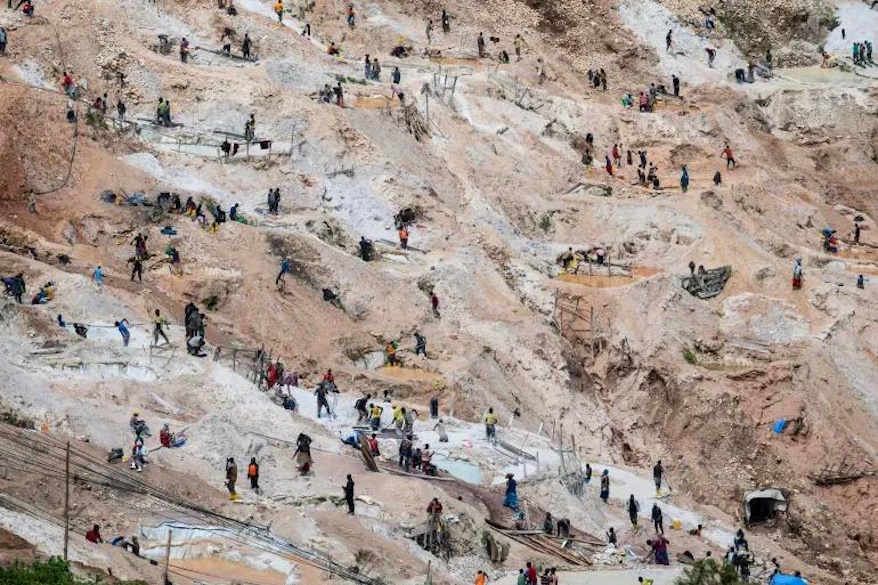
More than 200 people are believed to have lost their lives after a devastating landslide engulfed artisanal mining pits at the Rubaya coltan mine in the Democratic Republic of Congo, according to media reports on Thursday. The disaster, triggered by relentless heavy rainfall, has once again highlighted the perilous conditions faced by miners in the region.
The DRC’s Ministry of Mines confirmed the grim toll, stating on Wednesday that a significant number of the victims were children, with approximately 70 minors believed to be among the dead. The precise ages of the children have not been released, but their presence underscores the widespread, often informal, nature of artisanal mining where families work side-by-side in search of valuable minerals. Rescue efforts are ongoing, but the focus has largely shifted to recovery. The injured have been evacuated to medical facilities in Goma, the provincial capital of North Kivu, for urgent treatment.
This latest catastrophe occurred following a period of intense rainfall that saturated the ground, destabilizing the slopes of the open-pit mine and triggering a massive mudslide that buried dozens of makeshift mining operations. The inherent instability of such sites, which lack the basic safety infrastructure of industrial mines, makes them exceptionally vulnerable to seasonal weather patterns.
Heartbreakingly, this is not an isolated incident at the Rubaya site. A near-identical tragedy unfolded just months ago, in late January, when intense rainfall also triggered a landslide that claimed the lives of more than 200 people. The recurrence of such a large-scale disaster within such a short timeframe raises urgent questions about the enforcement of safety regulations and the desperate economic conditions that force miners back to the same deadly slopes.
The Rubaya mine is a critical node in the global supply chain for electronics and high-tech manufacturing. The area is renowned for its rich deposits of coltan (columbite-tantalite), and it is estimated to supply about 15 percent of the world’s output. After extraction, coltan is processed to produce tantalum, a heat-resistant and corrosion-proof metal. Tantalum is an essential component in the production of capacitors used in a vast array of modern devices, including mobile phones, personal computers, video game consoles, and advanced aerospace equipment and gas turbines.
The tragedy casts a stark light on the paradox of the modern tech industry: the vital role of minerals like tantalum in powering the digital age, contrasted with the devastating human cost often borne by the communities where they are sourced. Calls are likely to intensify for greater transparency and accountability in the mineral supply chain, and for more robust protections for the artisanal miners who extract them under the most dangerous conditions.
Our Pashto-Dari Website


Support Dawat Media Center
If there were ever a time to join us, it is now. Every contribution, however big or small, powers our journalism and sustains our future. Support the Dawat Media Center from as little as $/€10 – it only takes a minute. If you can, please consider supporting us with a regular amount each month. Thank you
DNB Bank AC # 0530 2294668
Account for international payments: NO15 0530 2294 668
Vipps: #557320

Comments are closed.