
Trump-Xi Summit Live: US and China Leaders Hold High-Stakes Talks on Trade, Technology, Taiwan, and Iran

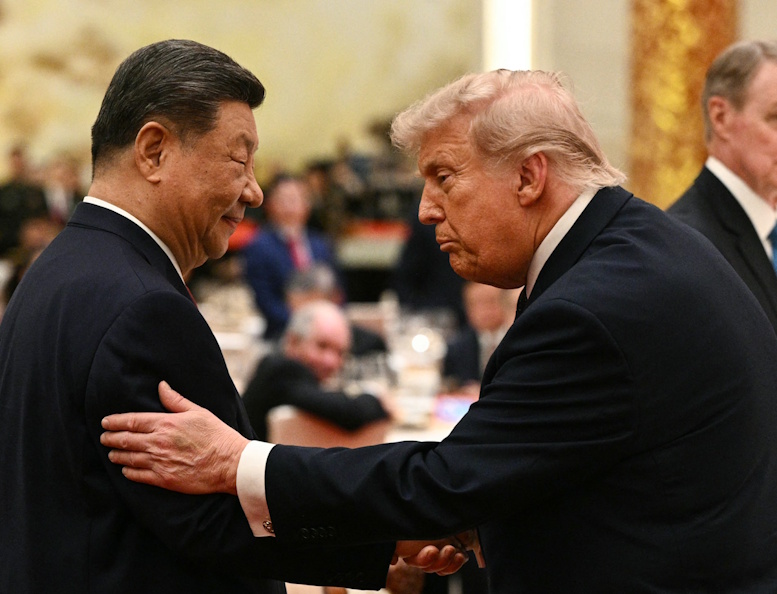
Beijing — Chinese President Xi Jinping and US President Donald Trump held extensive talks in Beijing on Thursday following an elaborate state welcome ceremony marked by military honors and ceremonial grandeur.
The summit, closely watched around the world, focused on critical issues shaping the future of US-China relations, including trade, technology competition, Taiwan, fentanyl controls, and the escalating tensions surrounding Iran and global energy security.
Opening the talks, Xi emphasized that while differences remain between the world’s two largest economies, their shared interests are far greater.
“The common interests between China and the United States outweigh their differences,” Xi said. “Cooperation benefits both sides, while confrontation harms both. Our two countries should be partners rather than rivals.”
Trump praised Xi’s leadership and described the Chinese president as “a great leader,” while stressing the need for stronger economic reciprocity between the two nations.
The US president reiterated his long-standing demand that China open its domestic markets more fully to American businesses and significantly increase purchases of US goods, particularly agricultural exports.
Meanwhile, Beijing is believed to have pressed Washington for concessions regarding Taiwan policy and the rollback of tariffs imposed during previous trade disputes.
Iran and the Strait of Hormuz Dominate Strategic Discussions
One of the most pressing topics was the worsening crisis in the Middle East.
According to a White House readout, Trump and Xi agreed that the Strait of Hormuz must remain open to ensure the uninterrupted global flow of energy supplies.
The strategic waterway typically handles nearly 20 percent of global oil and liquefied natural gas shipments, making any disruption a major threat to world markets.
Since the outbreak of hostilities between the United States, Israel, and Iran on February 28, Iran has sharply restricted shipping through the strait.
Complicating matters further, the United States has maintained its own naval blockade of Iranian ports despite a fragile ceasefire that took effect on April 8.
Trump reportedly urged Xi to use China’s influence to encourage Tehran to negotiate with Washington to bring the conflict to an end.
China remains Iran’s largest energy customer and one of Tehran’s most important diplomatic and economic partners.
Trade and Fentanyl Cooperation
The two leaders also discussed efforts to curb the flow of fentanyl precursor chemicals entering the United States.
The White House said both sides agreed to build on recent progress in restricting shipments of the chemicals used to manufacture the synthetic opioid, which has fueled America’s overdose crisis.
Economic cooperation was another major focus, with discussions including expanded Chinese purchases of US agricultural products, a longstanding priority for Trump.
Taiwan: Xi Issues Clear Warning
Though Taiwan was notably absent from the White House’s public summary of the summit, Chinese state media reported that Xi raised the issue directly in closed-door discussions.
According to Xinhua, Xi warned that careful management of the Taiwan issue is essential to preserving stability in US-China relations.
“If Taiwan is handled well, China-US relations will enjoy overall stability,” Xi reportedly told Trump.
He cautioned that mishandling the issue could lead to “clashes and even conflicts,” placing the entire bilateral relationship in jeopardy.
The warning reflects Beijing’s growing sensitivity over US military and political support for Taiwan, which China views as a breakaway province.
Xi Invokes the ‘Thucydides Trap’
In one of the summit’s most philosophically significant moments, Xi referenced the concept known in international relations as the “Thucydides Trap” — the theory that war often becomes likely when a rising power challenges an established one.
The term originates from the ancient Greek historian Thucydides, who described the Peloponnesian War as inevitable because of “the rise of Athens and the fear that this inspired in Sparta.”
Xi asked whether China and the United States could transcend this historical pattern.
“History, the world, and our peoples are asking whether our two countries can avoid the Thucydides Trap and forge a new model for relations between major powers.”
He added that the defining question of the era is whether Washington and Beijing can work together to meet global challenges and create greater stability for humanity’s future.
Trump Highlights Historical and Cultural Ties
Speaking at the official state banquet, Trump sought to underscore the historical connections between the two nations.
He referenced the role of Chinese laborers in building the American transcontinental railroads, which connected the east and west coasts of the United States in the 19th century.
Trump then turned to present-day cultural exchanges, noting how basketball an American invention has become enormously popular across China, while Chinese fast-food restaurants have become increasingly common throughout the United States.
The remarks appeared designed to frame US-China competition within a broader narrative of mutual cultural and historical interconnectedness.
A Carefully Warm Public Display Amid Deep Structural Tensions
Despite public praise and carefully choreographed diplomacy, deep tensions remain unresolved.
Trump’s relationship with Xi has been marked by years of friction, including:
- Two major trade wars
- Disputes over tariffs and market access
- Rising tensions over Taiwan
- US frustration over China’s role in fentanyl precursor exports
- Intensifying competition over advanced technology and semiconductors
Still, both leaders struck an unusually optimistic tone.
Xi concluded:
“The United States and China should achieve success together, pursue common prosperity, and chart a correct path for major-country relations in the new era.”
Whether the summit produces lasting breakthroughs or merely delays deeper confrontation remains uncertain, but the outcome will likely shape global politics and economics for years to come.
Our Pashto-Dari Website

Support Dawat Media Center
If there were ever a time to join us, it is now. Every contribution, however big or small, powers our journalism and sustains our future. Support the Dawat Media Center from as little as $/€10 – it only takes a minute. If you can, please consider supporting us with a regular amount each month. Thank you
DNB Bank AC # 0530 2294668
Account for international payments: NO15 0530 2294 668
Vipps: #557320

Comments are closed.