

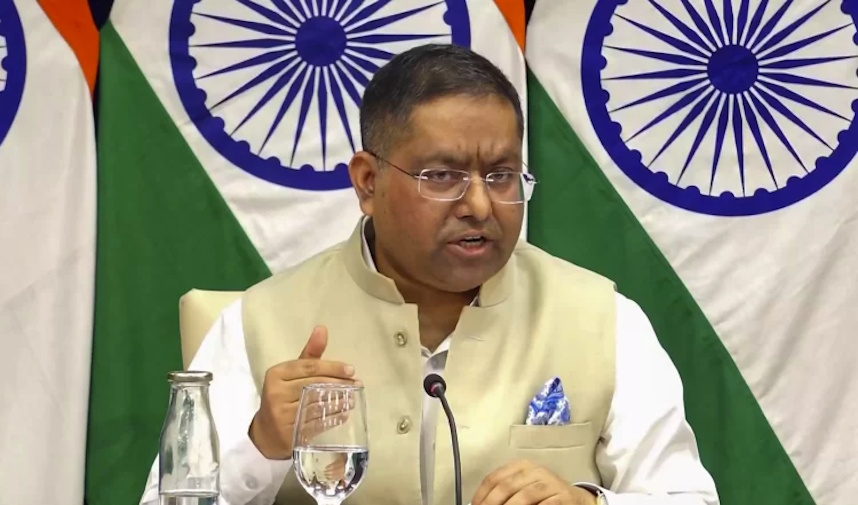
India is actively working to further strengthen its historical and multifaceted relationship with Afghanistan, with a renewed focus on expanding cooperation in development, trade, and regional connectivity, according to Indian Foreign Ministry spokesperson Randhir Jaiswal.
Speaking at a weekly media briefing, Jaiswal noted that recent high-level meetings and official visits between Indian and Afghan representatives have opened new avenues for bilateral engagement. “We see these exchanges as opportunities to deepen our partnership and advance shared interests,” he said. He emphasized that India remains committed to a sustained and constructive dialogue with Kabul, viewing greater interaction as essential for promoting stability and prosperity in the region.
Since the Taliban’s return to power in August 2021, India has maintained a calibrated engagement with Afghanistan, balancing diplomatic outreach, humanitarian aid, and economic cooperation. While New Delhi has not formally recognized the Taliban government, it has kept channels of communication open and continued to support the Afghan people through multiple initiatives. These include the supply of wheat, medicines, COVID-19 vaccines, and other essential relief materials, often delivered in partnership with international organizations such as the World Food Programme (WFP) and the World Health Organization (WHO).
India has also underscored the importance of regional connectivity as a pillar of its Afghanistan policy. New Delhi has actively participated in dialogue platforms such as the Moscow Format and the Tehran-hosted meetings on Afghanistan, and has supported infrastructure projects that link Afghanistan with Central and South Asia. The development of the Chabahar Port in Iran which serves as a strategic trade route for landlocked Afghanistan remains a key priority for India, as it enables the transit of goods and fosters economic interdependence.
Jaiswal’s remarks come at a critical juncture, as regional players including China, Russia, Iran, and Pakistan intensify their diplomatic and economic engagements with Afghanistan amid its prolonged political isolation and deepening humanitarian crisis. The United Nations and various aid agencies have repeatedly warned that Afghanistan is facing one of the world’s worst humanitarian emergencies, with over 28 million people in need of assistance and malnutrition rates reaching alarming levels among children.
Compounding these challenges are the Taliban’s restrictive policies, particularly against women and girls. Since taking control, the de facto authorities have barred girls from secondary education, restricted women’s access to employment, and imposed strict dress codes and movement limits. These measures have drawn widespread international condemnation and have been cited by donor nations as a major obstacle to scaling up development aid. Humanitarian organizations have cautioned that without a reversal of these policies, Afghanistan’s social fabric and long-term economic recovery will remain severely compromised.
India’s push to expand engagement thus unfolds against a complex backdrop: on one hand, there is an urgent need to address Afghanistan’s humanitarian plight and prevent economic collapse; on the other, there are growing international concerns over governance, human rights, and the erosion of women’s freedoms under Taliban rule. New Delhi has so far sought to navigate this duality by separating humanitarian assistance from political recognition, while quietly advocating for inclusive governance and respect for basic rights in bilateral and multilateral forums.
Looking ahead, India is likely to continue its pragmatic approach offering developmental support and trade facilitation while avoiding direct endorsement of the Taliban’s domestic policies. Whether this strategy can yield tangible improvements in Afghanistan’s stability and India’s strategic influence in the region remains an open question, but for now, New Delhi appears determined to keep the door open for dialogue and cooperation, even as the ground realities remain fraught with uncertainty.
Our Pashto-Dari Website

Support Dawat Media Center
If there were ever a time to join us, it is now. Every contribution, however big or small, powers our journalism and sustains our future. Support the Dawat Media Center from as little as $/€10 – it only takes a minute. If you can, please consider supporting us with a regular amount each month. Thank you
DNB Bank AC # 0530 2294668
Account for international payments: NO15 0530 2294 668
Vipps: #557320

Comments are closed.