

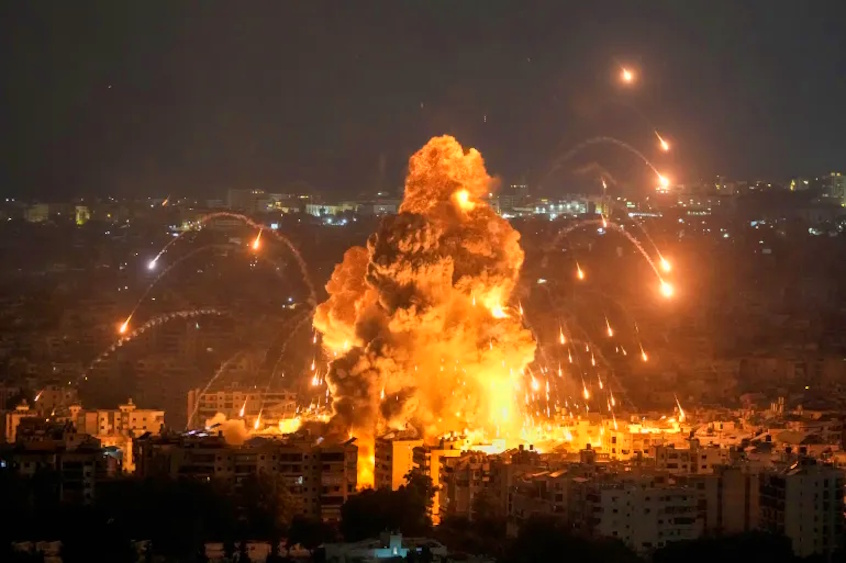
When the Israeli right invokes the term “Greater Israel,” it is usually understood as an expansionist concept aimed at enlarging the territory Israel claims as its own. This interpretation is certainly correct. Since its inception, Israel has been an expansionist state built on the displacement of Palestinians, and this process has now accelerated dramatically.
But what does the project of Greater Israel truly mean? What exactly do Netanyahu and the Israeli right intend by this term? And what are the regional and global consequences of such a project?
Greater Israel extends far beyond territorial expansion or settlement construction. It has evolved into a sweeping geopolitical project aimed at regional domination, transforming the Middle East into a permanent arena of conflict, violent confrontation with regional powers, and historic devastation.
Achieving this vision has required drawing the United States directly into war, alongside what many observers view as a deliberate effort to weaken the Gulf states—though many remain skeptical of whether such a strategy can succeed.
Over the past thirty months, Israel has effectively reduced Gaza to ruins and reoccupied it, resulting in the deaths and injuries of hundreds of thousands, the destruction of civilian infrastructure, and the confinement of Gaza’s population to only 12 percent of the already narrow strip.
In the West Bank, Israel continues an unprecedented campaign of destruction and forced displacement against Palestinians and their property, escalating territorial control and settlement expansion at levels unseen since the 1967 war.
Following the collapse of Bashar al-Assad’s regime, Israel seized Syrian territory beyond the occupied Golan Heights and is reportedly moving toward reoccupying southern Lebanon.
Ministers and members of Israel’s governing coalition have openly advocated imposing Israeli sovereignty and settlements in Gaza and Lebanon. Finance Minister Bezalel Smotrich called for Israel to “extend as far as Damascus,” while Netanyahu himself has claimed to feel a “deep connection” to this broader regional vision of Greater Israel.
A Geopolitical Strategy, Not Just Territorial Expansion
In an article for The Guardian, former Israeli negotiator Daniel Levy argues that Greater Israel is as much a geopolitical and strategic concept as it is a territorial one.
Occupation and territorial control are the visible dimension. But Netanyahu’s ambitions go further: he seeks a regional order built on new alliances and sustained by hard military power.
Weakening and Subordinating the Gulf States
After the October 7 attacks and Israel’s devastating response in Gaza, Israel’s regional integration project particularly normalization with Arab neighbors stalled.
Netanyahu faced a difficult choice:
- Resume normalization efforts by accommodating Palestinian political aspirations;
- Or maintain his “zero-option” position, rejecting any Palestinian political future.
By choosing the latter, Netanyahu effectively concluded that Iran must be removed from the regional balance of power a goal requiring broad, direct American military intervention alongside Israel.
Levy notes that just days before war broke out, two former Israeli security leaders argued in the Jerusalem Institute for Strategy and Security that key Sunni regional powers viewed either regime collapse or severe weakening in Iran as a development that would cement Israel’s status as the dominant regional power.
Achieving this, however, would require not only Iran’s weakening but also reducing Gulf Cooperation Council states to strategic dependence on Israel for security and energy-export routes.
The consequences of war including Iranian missile and drone attacks on Gulf states may therefore not be unintended side effects, but features of a broader Israeli design.
When Israel and the United States launched military escalation, Gulf access to world markets through the Strait of Hormuz was severely disrupted.
When Israel intensified attacks on Iranian energy infrastructure, Tehran retaliated by striking Gulf targets.
Netanyahu then seized the opportunity to advocate “alternative routes to bypass Hormuz and Bab al-Mandab,” envisioning oil and gas pipelines extending westward across the Arabian Peninsula into Israel and onward to Mediterranean ports.
The “Hexagonal Alliance”
In public remarks, Netanyahu has outlined elements of his vision for regional dominance.
During a visit by Indian Prime Minister Narendra Modi, Netanyahu described his idea for a “comprehensive hexagonal alliance” surrounding or operating within the Middle East, including:
- India
- Arab states
- African states
- Mediterranean states (particularly Greece and Cyprus)
- Asian partners
- Israel at the center
A recent Hebrew-language article by senior analysts at Israel’s official military strategy institute elaborated on this concept.
They argued that the Israeli military would no longer merely invade and occupy land but would establish “operational control over distant areas without direct territorial administration.”
This would grant Israel what they termed the status of “queen of the jungle” a phrase often used in Israeli political rhetoric to describe dominance over the broader Middle East.
Netanyahu has recently begun referring to Israel not only as a regional superpower but occasionally as a global superpower.
Israel seeks to position itself at the heart of a regional alliance capable of surviving even if American influence declines.
He has also framed this alliance as a bulwark against both the “radical Shiite axis” and an emerging “radical Sunni axis.”
Israel’s next declared strategic threat, increasingly, is Turkey.
A Dangerous Overreach
Some analysts dismiss talk of Greater Israel as wartime exaggeration.
Yet recent Israeli policy suggests otherwise.
A permanent-war orientation is deeply embedded across Israel’s political class—government and opposition alike—as well as within security institutions, emerging right-wing movements, and much of the media.
But this mindset carries severe risks of strategic overstretch and intense regional backlash.
It is dangerous not only for the region, but potentially for Israel itself.
The Middle East is unlikely to accept such domination indefinitely.
Why the Project Harms the United States
Netanyahu has repeatedly declared:
“I promised you we would change the face of the Middle East.”
This vision, however, has imposed enormous costs on Washington.
According to American researcher John Hoffman of the Cato Institute, this strategy reflects the same arrogance that shaped previous failed attempts to reorder the Middle East through force.
Over the last thirty months, Washington has underwritten Israel’s regional military campaign, paying steep political, economic, and strategic costs.
Continued unconditional support guarantees permanent conflict at the expense of American interests.
Hoffman argues that the U.S. has repeatedly attempted to dominate the Middle East militarily, accumulating immense costs while producing few real benefits.
This latest effort is no exception.
American backing for Israel has fueled widespread anti-American sentiment while preserving the conditions for future instability and conflict.
The likely outcome is endless regional disorder and permanent American military entanglement.
There is no genuine U.S. interest in perpetual Middle Eastern war.
A Vision of Endless Destruction
British historian and journalist Andy Worthington warns that Israel’s refusal to exercise restraint reveals an unprecedented degree of political arrogance.
The disruption of the Strait of Hormuz alone triggered a global energy shock whose scale, he argues, Western political and media institutions have deliberately downplayed.
Israel’s actions in Lebanon further illustrate this pattern.
On April 8, in what critics described as a deliberate provocation aimed at undermining a U.S.–Iran ceasefire, Israel launched one of its most destructive attacks on Lebanon, striking more than 100 targets in ten minutes and killing hundreds of civilians.
Israel has continued devastating southern Lebanon village by village.
It has also faced international condemnation for assassinating Lebanese journalist Amal Khalil and subsequently labeling her a “terrorist.”
As Israeli military escalation intensifies, the project increasingly resembles permanent multi-front war, involving not merely military operations but systematic destruction of civilian societies deemed associated with resistance.
A Model for Western Authoritarianism
Israel’s influence extends beyond the Middle East.
Its expansive claim of “self-defense” has shaped Western governments especially the United States, Britain, and Germany not only as weapons suppliers but as active suppressors of protest, free speech, and direct action undertaken in solidarity with Palestinians.
Some critics argue that Israel has become a laboratory for modern authoritarianism:
- violence legislation
- racialized control systems
- surveillance technologies
- repression methods
- mechanisms of collective punishment
As the Greater Israel project advances, these systems may spread further into Western political life.
A Catastrophe in Formation
Worthington warns that Gaza risks becoming the template for a future world of limitless massacres, total surveillance, and comprehensive domination.
As long as Israel is permitted to exercise power without consequence, this model will persist.
He therefore argues that, for the sake of all societies:
Israel and its enablers must be restrained, disarmed, and stripped of the tools that sustain their coercive power.
Similarly, American physician and writer Josh Bazell contends that Israel’s long-term project points toward territorial expansion into:
- فلسطين (Palestine)
- لبنان (Lebanon)
- الأردن (Jordan)
- سوريا (Syria)
- مصر (Egypt)
- العراق (Iraq)
Such expansion, he warns, would displace millions and cost hundreds of thousands of innocent lives.
The deeper danger lies in Western inaction or active support.
Israel and its leadership continue to evade accountability for repeated allegations of war crimes while receiving political privileges and military support unavailable to nearly any other state.
Bazell’s conclusion is stark:
Greater Israel is not a theoretical concept. It is an active political project already underway.
And if left unchecked, it could become one of the greatest and most destructive catastrophes of our era.
Our Pashto-Dari Website

Support Dawat Media Center
If there were ever a time to join us, it is now. Every contribution, however big or small, powers our journalism and sustains our future. Support the Dawat Media Center from as little as $/€10 – it only takes a minute. If you can, please consider supporting us with a regular amount each month. Thank you
DNB Bank AC # 0530 2294668
Account for international payments: NO15 0530 2294 668
Vipps: #557320

Comments are closed.