

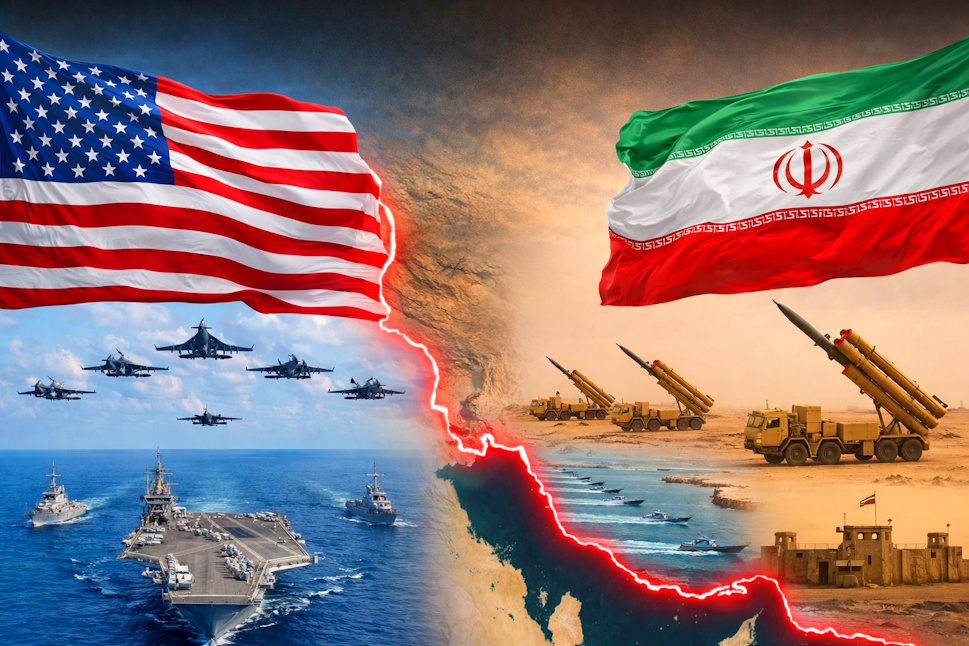
The United States launched a series of military strikes against Iran early Wednesday, retaliating for what it called deliberate attacks on three commercial vessels in the strategic Strait of Hormuz a critical chokepoint for nearly one-fifth of the world’s oil supply.
The US Central Command (CENTCOM) confirmed that American forces struck multiple Iranian targets, including coastal air defense systems, surveillance radars, and over 60 fast-attack craft operated by the Islamic Revolutionary Guard Corps (IRGC). These small, swarm-capable boats have been increasingly used to intercept, board, or harass merchant ships in the waterway over the past month, according to Pentagon officials.
“These precision strikes were conducted to impose severe and immediate costs for targeting and endangering innocent civilian mariners in an international waterway,” CENTCOM said in a statement. “The United States remains fully postured and prepared to hold Iran accountable when agreements are violated or when freedom of navigation is threatened.” The military added that this round of strikes had concluded, but emphasized that further action remained possible.
Iranian state media acknowledged the US attacks, reporting explosions in the coastal cities of Bandar Abbas, Qeshm Island, and Sirik, though Tehran offered no immediate comment on casualties or material losses. IRGC commanders have not yet issued a formal response, but semi-official news agencies warned of “proportional retaliation” in the coming hours.
Funeral Tensions and a Fragile Diplomatic Window
The strikes come during the final days of an extended funeral process for Iran’s Supreme Leader, Ayatollah Ali Khamenei, who died at age 86 on February 28—reportedly in the opening hours of the broader conflict. The massive mourning ceremonies, which have drawn millions of flag-waving mourners across Iran, were initially seen by international observers as a potential lull in hostilities. Instead, they have become a backdrop for escalating rhetoric: crowds in Tehran, Mashhad, and Qom have repeatedly chanted for the deaths of US President Donald Trump and Israeli Prime Minister Benjamin Netanyahu, with some state-aligned clerics framing the strikes as a divine test of Iran’s revolutionary resolve.
The funeral procession, set to conclude Thursday with Khamenei’s burial in the holy city of Mashhad, had been widely viewed as a brief window for quiet diplomacy. Negotiators from the US, Iran, and European intermediaries had reportedly planned to resume high-stakes talks immediately after the burial, aiming to finalize a long-anticipated deal. That agreement would have addressed the two most explosive issues: the full reopening of the Strait of Hormuz to unhindered commercial traffic, and verifiable, phased rollbacks of Iran’s nuclear enrichment program which has recently reached 84% purity, dangerously close to weapons-grade levels.
Diplomatic Fallout and Uncertain Next Steps
Wednesday’s strikes have now thrown that diplomatic timeline into chaos. European mediators, speaking on condition of anonymity, expressed deep frustration, with one senior diplomat calling the attacks “a major setback” that could “collapse the fragile trust needed for final-phase negotiations.” Meanwhile, Israel, which has long advocated for a harder line against Tehran, offered public support for the US action, with Defense Minister Yoav Gallant stating that “appeasement emboldens aggression—Israel stands firmly behind America’s right to self-defense.”
Oil markets reacted sharply, with Brent crude surging over 4% in early Asian trading on Thursday, reflecting renewed fears of a full-scale blockade or broader regional war. The US Navy’s Fifth Fleet, based in Bahrain, has increased patrols and is now escorting all allied-flagged vessels through the strait, while Iran’s naval forces remain on high alert, conducting unannounced drills near the entrance to the Gulf of Oman.
Human Toll and Global Reactions
While the US has not reported any casualties among its forces, the initial ship attacks which Tehran denies orchestrating resulted in at least two injured mariners and significant damage to a Greek-flagged tanker, according to maritime tracking data. The UN Security Council has scheduled an emergency session for later Thursday, though deep divisions between Western powers, Russia, and China are likely to prevent any unified action.
For now, the world watches as Iran’s mourning turns into defiance, and as a diplomatic breakthrough that once seemed within reach now hangs by a thread. Whether the strikes serve as a punitive finale or a prelude to wider conflict may depend on Tehran’s next move and on whether buried diplomatic channels can be unearthed before the strait becomes a battlefield once more.
Our Pashto-Dari Website

Support Dawat Media Center
If there were ever a time to join us, it is now. Every contribution, however big or small, powers our journalism and sustains our future. Support the Dawat Media Center from as little as $/€10 – it only takes a minute. If you can, please consider supporting us with a regular amount each month. Thank you
DNB Bank AC # 0530 2294668
Account for international payments: NO15 0530 2294 668
Vipps: #557320

Comments are closed.