

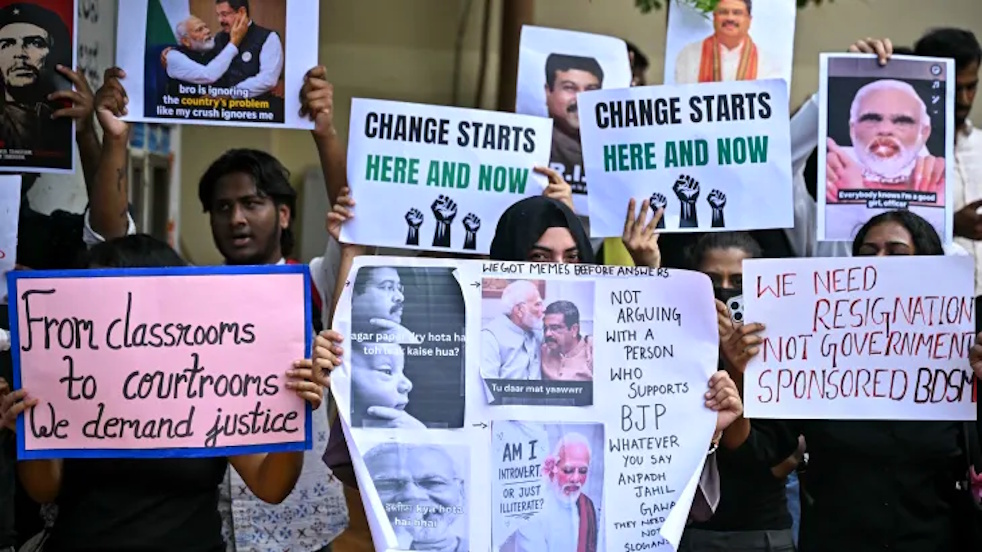
NEW DELHI (AP) — India’s Education Minister Dharmendra Pradhan resigned on Saturday, marking a significant concession to the youth-led “Cockroach” movement after weeks of escalating protests over alleged leaks in the country’s most competitive entrance exams and broader systemic failures in the education sector.
Pradhan announced his decision in a post on X, handing a major victory to the movement, which has spearheaded nationwide demonstrations, sit-ins, and hunger strikes. His resignation marks the first significant concession by Prime Minister Narendra Modi’s government to one of the most visible waves of public dissent it has faced in recent years. The government has rarely yielded to sustained public pressure during Modi’s more than 12 years in office; the most notable exception came in 2021, when it was forced to withdraw controversial farm laws after a yearlong farmers’ protest.
News of Pradhan’s resignation sparked celebrations among the thousands of protesters who have camped at New Delhi’s protest site for more than a month. Many embraced each other, waved the Indian flag, and chanted slogans. Prachi Kumar, a corporate employee who joined the protests, said Pradhan’s resignation was necessary to restore accountability in the education system. “This had to be done. Someone must be held accountable,” she said.
The Cockroach Janta Party (CJP), the satirical online movement that launched the protests, declared victory following the resignation, writing on X: “DEMOCRACY WINS!”
What is the protest about?
The protests began more than a month ago after allegations of leaks in some of India’s biggest entrance exams, including the National Eligibility cum Entrance Test (NEET) for medical schools, which is taken by more than two million students each year. Examination papers have leaked three times in the past five years, including this year, triggering outrage over technical faults, cancelled tests, and the perceived impunity of those responsible.
What started as a call for education reforms has grown into a broader protest over unemployment, government accountability, and economic opportunities. Students, professionals, families, and activists have joined rallies in New Delhi and other cities, including Mumbai, Bengaluru, and Patna.
The main protest site is Jantar Mantar in New Delhi, a historic 18th‑century astronomical observatory close to Parliament Street. Demonstrators have also occupied parts of Parliament Street since Monday, with many camping on the key thoroughfare that connects Parliament House to Connaught Place, the capital’s central commercial square.
The site has seen bouts of unrest and violence this week. On Monday, the protests escalated after police fired tear gas and baton-charged demonstrators as they tried to march to Parliament. Several students were injured in the crackdown, intensifying anger among demonstrators. Rights groups Human Rights Watch and Amnesty International condemned the Indian government over the “excessive use of force” by police and the suspension of mobile internet services at Jantar Mantar.
Wangchuk calls off hunger strike, but students hold firm
Late on Thursday, Prime Minister Modi promised stern action against perpetrators of the paper leaks, addressing students in an Instagram-style phone recording—his first spoken response to the protests. Modi pledged to set up fast-track courts to punish those involved and vowed that “those who try to harm the future of our youth will not be spared.”
The same night, Indian activist Sonam Wangchuk, a supporter of the students, called off a 26-day hunger strike aimed at pressuring the government to respond to their demands. Wangchuk, 59, said he ended his fast after “a long negotiation on various conditions and in view of possible violence in the country.” His fast was broken in the presence of Indian Health Minister JP Nadda and junior Atomic Energy Minister Jitendra Singh, who offered Wangchuk his first sip. Nadda later stated that the government was positive about not registering cases against peaceful protesters and was considering suitable compensation for families of students who died by suicide after recent exam cancellations.
However, student activists said they would continue their agitation until Pradhan stepped down. The CJP’s demands included Pradhan’s immediate resignation, the dropping of cases against peaceful demonstrators, and 10 million rupees ($104,000) in financial assistance for each of the families of more than 20 students who have died by suicide since the exam cancellations.
Government talks and Modi’s response
Hours after Wangchuk ended his hunger strike, two senior government ministers and two leaders of the CJP met for talks, raising hopes of a breakthrough. Modi wrote on X: “Nothing is more important than the welfare and future of our youth!” He also announced fast-track courts to ensure swift punishment for those involved in paper leaks.
But the measures failed to satisfy protesters, who said they did not address government accountability. CJP spokesperson Ashutosh Ranka dismissed Modi’s judicial proposal as insufficient, stating: “The announcement of fast-track courts is not a real solution. It is merely a distraction. Paper leaks are not happening because India lacked fast-track courts. They are happening because Education Minister Dharmendra Pradhan has been completely incompetent.”
On Thursday, the Delhi Metro Rail Corporation announced that 16 Metro stations in New Delhi would be closed until further notice. In response, CJP founding president Abhijeet Dipke wrote on X: “Modi is ready to shut down all of Delhi, but not sack Dharmendra Pradhan.”
What’s next?
After the Friday meeting, CJP leaders said the government asked to be given until Saturday afternoon to respond to their demand for Pradhan’s resignation. A senior government minister said the government was always open to talks and would not “stand on prestige.” Pradhan’s resignation on Saturday met the movement’s main demand, but leaders said their campaign would continue as they sought compensation for the families of suicide victims and action against police officers they accused of using excessive force.
“Remember, do not mess with the cockroach,” Dipke said in a written statement. The demonstrations have become one of the most persistent challenges to Modi’s government in recent years, with thousands returning to the streets even after police used tear gas and batons to disperse marchers. While the resignation is a major victory, the movement’s broader demands for systemic reform and accountability suggest that the protests may not yet be over.
Our Pashto-Dari Website

Support Dawat Media Center
If there were ever a time to join us, it is now. Every contribution, however big or small, powers our journalism and sustains our future. Support the Dawat Media Center from as little as $/€10 – it only takes a minute. If you can, please consider supporting us with a regular amount each month. Thank you
DNB Bank AC # 0530 2294668
Account for international payments: NO15 0530 2294 668
Vipps: #557320

Comments are closed.