
‘The Largest Funeral in Palestinian History’: Gaza Buries 112 Souls Recovered Nearly Three Years After Israeli Airstrike

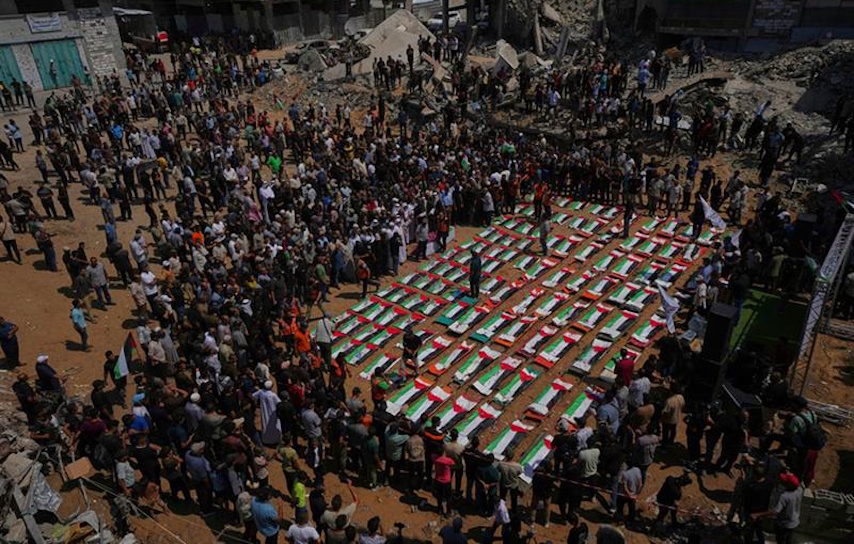
Gaza City – For nearly three years, they lay entombed beneath the shattered concrete and twisted steel of a neighborhood that no longer exists. On Tuesday, the remains of 112 Palestinians killed in a single Israeli airstrike during the opening weeks of the war were finally carried through the streets of Gaza City in what mourners are calling the largest funeral procession in Palestinian history.
The bodies were among more than 300 people who perished on November 22, 2023, when Israeli warplanes obliterated a densely packed residential block in the Sabra neighborhood. That strike, one of the deadliest single attacks of the conflict, came as Israel launched its devastating military offensive in response to the October 7 Hamas-led incursion. For the families of the missing, the years of silence were a secondary torment an agonizing limbo with no grave to visit, no closure to grasp.
The recovery operation, led by Gaza’s Civil Defence, began more than two weeks ago and stretched over 136 painstaking hours of manual excavation. Working by hand in the southern part of Gaza City where heavy machinery is scarce and the ground is unstable rescue crews sifted through layers of collapsed homes, pulverized concrete slabs, and mangled rebar. The agency announced over the weekend that the remains had been exhumed and identified, though 157 others are still believed to be buried in the same rubble, their fates unknown.
Among the recovered dead were 40 children, 38 women, and seven people with disabilities a demographic profile that has come to define much of the war’s civilian toll. The Civil Defence described the operation as one of the most grueling recovery efforts since the conflict began, with teams working in shifting debris and under constant threat of secondary collapse.
“The search for the missing and the recovery of bodies is not merely a logistical task it is a critical humanitarian imperative,” said Amani al-Naouq, spokesperson for the International Committee of the Red Cross in Gaza, speaking to AFP. She emphasized that such operations demand immense time, specialized tools, and fragile coordination among warring parties, all of which remain in short supply across the besieged enclave.
Colonel Mohammed Abu Dan, who oversees the Civil Defence’s body recovery project, described the scene in visceral terms. “We dug through layers of death,” he told local media. “Every slab we lifted, every piece of metal we cut, we knew we were bringing someone home. But the conditions are beyond desperate we use our hands because we have no other choice.”
Tuesday’s funeral transformed the ruined outskirts of Sabra into a sea of grief and defiance. Hundreds of mourners men in traditional white shrouds, women in black, children clutching faded photographs gathered as the bodies, wrapped in Palestinian flags, were laid in neat rows upon the dust-caked ground. For a moment, the only sound was the wind and the muffled sobs of relatives who had waited years for this day. Then, pallbearers hoisted the stretchers onto their shoulders and wove through the narrow, debris-lined streets toward a nearby cemetery, where mass graves had been prepared.
The November 2023 airstrike on Sabra was part of a broader bombardment that, according to the Palestinian Health Ministry, has now killed at least 73,375 Palestinians and wounded 174,162 across the Gaza Strip since October 2023 the majority of them women and children. International humanitarian organizations have repeatedly called the figures conservative, citing the collapse of health infrastructure and the thousands still missing.
Beyond the counted dead, experts estimate that more than 10,000 Palestinians remain entombed beneath the ruins of destroyed homes, schools, and shelters across Gaza. Many have been buried for months or years, unreachable due to ongoing hostilities, lack of heavy equipment, and the sheer scale of devastation that has reduced entire city blocks to featureless mounds of gravel.
For the families of the 112 laid to rest on Tuesday, the funeral brought both an end to their waiting and the beginning of a new grief the finality of soil upon a flag-draped body. But for the hundreds of other families still searching, the recovery in Sabra offers a sliver of fragile hope: that beneath the rubble, their loved ones have not been forgotten, and that one day, they too may be brought home to be mourned, remembered, and finally at peace.
Our Pashto-Dari Website

Support Dawat Media Center
If there were ever a time to join us, it is now. Every contribution, however big or small, powers our journalism and sustains our future. Support the Dawat Media Center from as little as $/€10 – it only takes a minute. If you can, please consider supporting us with a regular amount each month. Thank you
DNB Bank AC # 0530 2294668
Account for international payments: NO15 0530 2294 668
Vipps: #557320

Comments are closed.